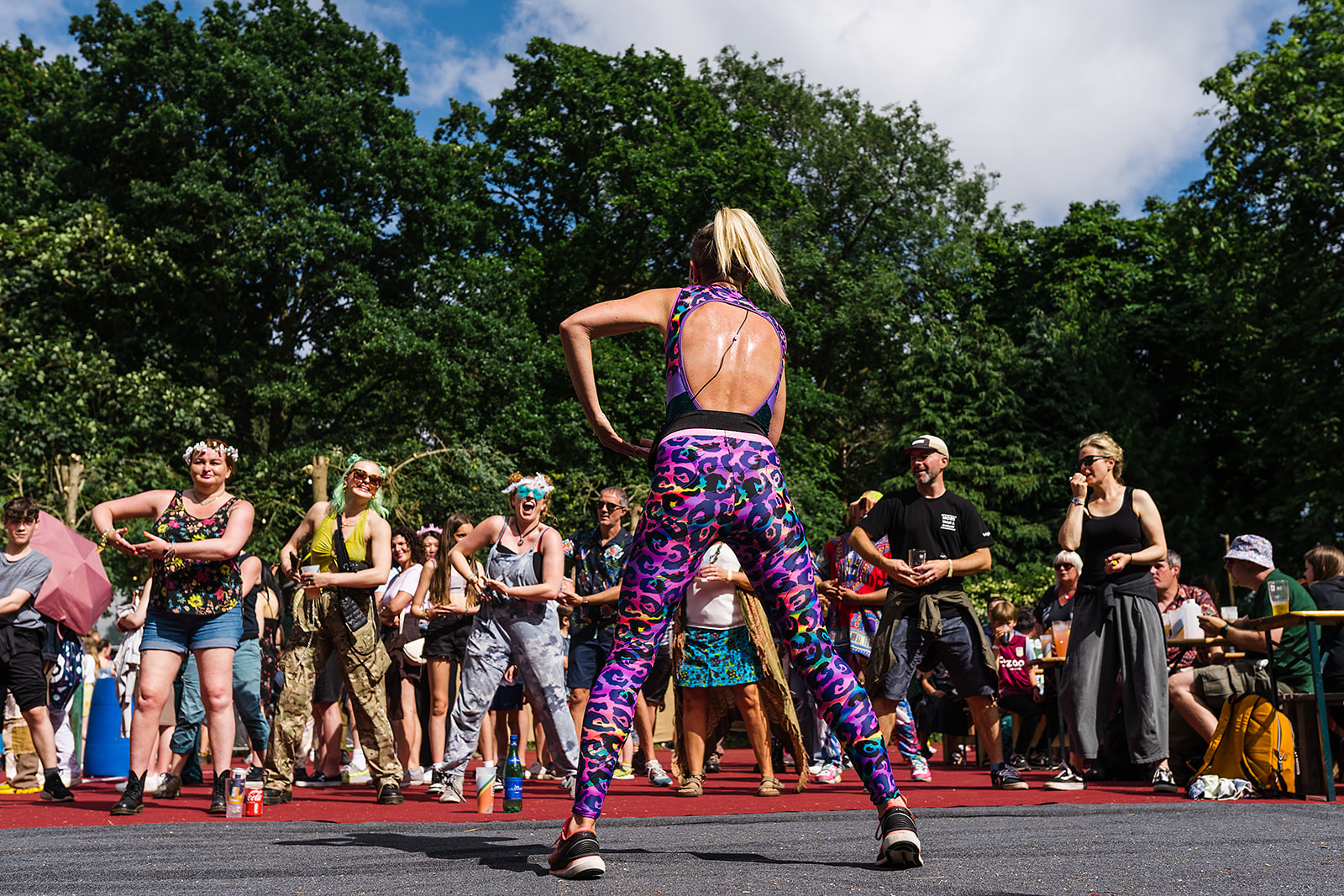

This week we kick off a new run of episodes where we hand the guest chair over to the artists coming to Venue 13 this August. First up is the brilliant Emma Smallman, founder of Drum n Bounce and the mind behind The Drum & Bass Aerobics Experience, which lands at Venue 13 for its first-ever Fringe run.
Emma paints the picture of what a 10:30am drum & bass aerobics class actually is — the “joy bubble,” the collective experience, and why moving your body with a room full of strangers might be exactly the reset the Fringe marathon needs. No pressure to get the moves right; the only rule is that you move and have fun.
We trace the origin story back to a Friday night in 2012, a bit of drum & bass and some aerobics moves that turned into a Eureka moment, through the first classes in Birmingham and a breakthrough at Shambala, to nearly fourteen years of opening main stages from the Commonwealth Games to the Eurovision Fan Zone. Emma also talks about the wider mission underneath it all — her work as DJ Sister Smalls, her radio show, and her trauma-informed yoga in prisons, probation hostels and recovery settings — and how accessibility and wellbeing tie every one of those hats together. It fits neatly with what we’re trying to build at Venue 13: a space that’s about community and wellbeing, not just theatre.
Show Notes & Links
Catch up first
- Last episode: AI Campfire [Return], a Festivals Research Mention and an Ecoscenography Residency in Argentina
- The full Edinburgh Fringe 2026 programme is on sale now
- Support our renewables-powered vegan food trailer (even though it has ended)
The Drum & Bass Aerobics Experience
- The Drum & Bass Aerobics Experience at Venue 13 — 10:30am, running 14, 15, 16, 22 & 23 August. Tickets £16 (£14 concessions), capacity-limited, so book ahead
- Emma’s company: Drum n Bounce — dance fitness to custom drum & bass mixes, founded in Birmingham, October 2012. Ages 16+; wheelchair users welcome and low-impact modifications cued throughout
- Emma behind the decks: DJ Sister Smalls
- Follow along: @drumnbounce on Instagram
Wellbeing, DJing & trauma-informed yoga
- Emma trained with the Prison Yoga Project and the Phoenix Prison Trust, and delivers trauma-informed yoga in prisons, probation hostels, recovery centres and other settings [TODO: confirm/adjust “Phoenix Prison Trust” wording and link if you have one]
- Emma’s radio show, Find Your Happy Place [TODO: add station/listen link if available]
- Shambala Festival — an early inspiration for the festival-fitness side of Drum n Bounce, and where Emma first took the class to a festival crowd in 2013
Find us
- Episodes & transcripts: venue13.com
- Socials: @venue13fringe
- Get in touch: podcast@venue13.com
- In person from August: Venue 13, Harry Younger Hall, Lochend Close, Edinburgh
- Music by Dusty Decks via Epidemic Sound
Transcript
Vanesa on this is episode thirteen because we are venue thirteen. Haha. I wanted to say that um. So yes, we are uh, really in the process of getting ready for the fringe. Now what we’re going to do with these, uh, the next series of podcasts is to interview the artists. They’re going to be at twenty thirteen this August.
Ian This week we welcome Emma Smallman. She’s the founder of Drummond Bounce and the mind behind the drum and Bass Aerobics experience, which will be at venue thirteen this August for its first ever fringe run. Come and find your happy bass at venue thirteen this August, which works really well for us. It works with our vegan theme because you could also find a happy pass.
Vanesa The happy.
Ian World, a bass.
Vanesa A bass.
Ian Yeah, it’s a freshwater fish.
Vanesa No, no.
Ian Okay, I’ll cut that out. Maybe I’ll leave this part out. Our guest this week is the brilliant Emma Smallman, the founder of Drummond Belts, who is bringing the drum and bass aerobics experience to venue thirteen for its first ever fringe run. Emma, welcome to podcast thirteen.
Emma Smallman Oh, thank you so much. I’m very excited to be here chatting to you today.
Vanesa Hi, Emma. Welcome to podcast thirteen. For anyone who has never heard or thought about you or doing a drum and bass aerobics class in the morning, do you want to paint the picture for them? Why should they do it? Do you recommend someone starting their day in this way? Like get the festival away? Like that kind of emotion?
Emma Smallman Absolutely. I mean, I’m a big advocate for doing any sort of movement every morning. But yeah, even more so at the fringe. And so basically drum and bounce is a really uplifting experience. And it’s dance fitness aerobics, no pressure to get anything right. Of course, it’s more about having fun, but the music is so magnetic and it just like carries you like a wave. And so even if you’re not coordinated anything like that, it doesn’t matter because what happens in drum and bounce and some participants, I’ve had people call it like this joy bubble because we’re all coming together. It’s a collective experience. It’s this moment where because you’re sort of concentrating on listening to the music, what moves are coming? Nothing else sort of exists within that time because you’re fully present. So it’s just a perfect way to start the day. You come out of your mind and into your body, and it gets all your systems fired up and started, and you get all the endorphins and the euphoria both in the session and afterwards. And there’s something really lovely that happens when you move with other people in that even if you’ve not spoke to them when you walked in the door, you come together in that moment because we’re, we’re, we become like synchronized. Our heartbeats start beating at the same beat. We’re listening to the music. We have those moments of joy. We laugh when we get it wrong. And, you know, these shared experiences, I think, have just become an even more important. The more we’re living in a virtual world. We’re on our phones a lot. The sort of power of being in a space with other people and moving together, I think is just becoming even more essential, not just for physical health, but for mental health. And yeah, the power of connection. So I think it’s a marvelous way to start your day if you come into hinge, because it just like kickstarts fires things off and, you know, you might meet some people as well, which is a really lovely thing. And to start the day.
Vanesa Absolutely. It really sets the tone for the day as well, because I really like Ian. You can actually relate to this in a way. We’ve actually had the conversation. The fringe can be quite a static thing from a physical perspective. You know, you’re queuing, then you’re sitting down, then you’re queuing again and you’re sitting down. And to start the day with like, you know, shake it all off to be like, I’m ready for this. It must be like a fantastic opportunity.
Ian A lot of people refer to the fringe as like a bit of a marathon. So it’s good, like it’s important to have a warm up before you get into everything, especially because, you know, yes, it is a lot of a lot of stillness as well. I know that when I was, you know, when we were setting up for this, this conversation we were passing backtracks. And also when we were getting things listed, like you have a Spotify playlist that we’ve embedded within the website so that people can hear some of the music that you’re going to be bringing into the space. Like it’s also hard, like when you were referring to so much time being on your screens and so much time in like this virtual space. I’m like, oh yeah, I was setting up the website and I just wanted to like, get up because of the music.
Vanesa Have a little dance.
Ian Yeah. Yes. Well, and when we were talking about music and what we might be able to bring into this episode too, I was like, yeah, I think I just like, I just want to go for a run now. Like I just want to like, get up and move.
Emma Smallman It might inspire healthy choices throughout the rest of the day in the festival as well. And obviously, you know, people might be coming and indulging at the festival and that’s great too, because it’s all about balance, but it might help if you’ve had a heavy night the night before. It could just, you know, totally reset you for the day ahead. Or you might then as a result, go, oh, I’m going to have a little walk around the block after in between shows and, you know, so it might just inspire some healthy choices throughout the event as well, which is great for your wellbeing.
Ian Which is, which is an excellent tip for the festival in general, can be really easy to put those aside for the month of August while you’re at the fringe. you’ve been doing this since twenty twelve? Yeah. Can you take us back to like where the idea came from? Like combining like the drum and bass, like a ray of aesthetic with an aerobics class. Like, what was the spark that brought that together?
Emma Smallman Yeah, totally. Well, I used to go when I first started going out raving to drum and bass nights. It was back in the early nineties, and it just had a real. The music had a real visceral effect on me. And, and, and then similar to you saying you heard the music and it makes you want to run. So beyond the sort of raving time, if I ever heard drum and bass music come on, I would either need to sprint or I’d need to dance, or it just did something that almost like I wasn’t in control of it. The music kind of had this powerful impact. And then I became an aerobics teacher back in two thousand and four. But I just found it all a bit boring. I thought the music was a bit boring. And anyway, I was around it and it’s just, well, just before twenty twelve and it was a Friday night and we had the drum and bass on and I started teaching some aerobics moves to it. And wouldn’t this be like, this would be the perfect aerobics class because it’s really fast. But also you get those connotations of a night out. You can’t help but sort of feel that like physical excitement I do anyway. And I now know lots of other people do when you hear drum and bass. And so I was just like prancing around and showing him the moves and he was copying me. And then we were like, this would be such a good class. And you could call it jumping bass or drum and bounce. We were, oh, Eureka! So my brother was a DJ at the time. He started putting some mixes together. Initially for me. I started creating some dance moves, and then I got a space for free for a month and I said, I’m just going to put on classes and just see, you know, anyone can come and friends and friends of friends and, and also Shambala Festival was a big inspiration because they do a lot of dance workshops. And I was doing dance workshops there going, oh, I could do this. I could do this drum and bounce here. It would go down a treat. And that inspired me. And so yeah, I started October twenty twelve and by August twenty thirteen, I was doing it at Shambhala, which really like propelled the whole festival fitness thing, which drum and bounce is. I guess it’s one of its niches really.
Vanesa Yeah, yeah, I saw, I saw that, you know, and just like that, you started and then it’s nearly fourteen years on now. Yeah. And you’ve opened many main stages and played everything from Commonwealth Games to Eurovision Fun Zone. Like, did you ever imagine it would grow, like grow into this or get this big?
Emma Smallman No. Like the the big events, the festivals. Yeah, those big stages are just amazing. I’m like, come on, bigger stages, more people.
Vanesa Bigger stages, more.
Emma Smallman Yes. Yeah. And the big events and, and it’s great because similar to what we’re talking about with the fringe, you know, it’s the importance of people moving but enjoying it because you know, this like exercising, I don’t think should be a chore where you’re like, oh, I’ve got to do this thing that I don’t particularly want to do. Actually, if you are doing things that are fun and that you love, it’s going to be way more part of your routine and you’re going to get way more consistency with it. So I guess that’s one of my missions really, is to show you that you can exercise, get all those benefits, but it’s really good fun when you find the things that you like, be it written by the music that you love or the type of movement that you love or you know, whatever it is, keep trying things until you find what that is for you. Um, and yeah, luckily for a lot of people, it’s drum and bounce, which is great.
Ian Learning for them and for you. Yes. Yeah, yeah. And, and you’re wearing a lot of hats too, like you mentioned, your, your brother putting together a mix, but you’re also you’re, you’re DJ Sister Smalls. Yeah. Behind the decks. You’re also you do hosting. You also are like a trauma informed yoga teacher like how all of these different worlds feed into Drummond Bounds.
Emma Smallman Well, I guess the umbrella over all of these things is around well-being. So when I’m out deejaying, for me, it’s about creating like high vibrational experiences where people are just dancing with each other. You know, it’s that same collective experience that I talked about at the start with drum and bass. I feel the same thing with deejaying, and I also am quite passionate about and like deejaying in daytime and DJing at sober events so that it’s not all related to alcohol or substances or, but like you just creating that energy and through dance, through music. And so it kind of really connects with drum and bounce and, and then the trauma informed yoga. I teach in quite particular settings, which again for me is about creating opportunities for no matter where you are or who you are or what you’re doing, like the opportunities to come at wellbeing and find ways to really come home to yourself in your body. Because I think when you feel that way, um, life just is more, more comfortable. I think when you’re feeling good in yourself. So I like to bring that through the Trauma-informed yoga. And then my radio show is called Find Your Happy Place, which is again connected to wellbeing. And how do we feel good in ourselves and our. And sort of physical and mental state, be it through music, movement, whatever. So for me, whilst I have got many hats and doing lots of different things, they all come under the same thing.
Ian Yeah. I mean, extending that to like having, having trained with like the prison yoga program and the Phoenix prison, you’re delivering yoga in prisons, probation hostels, like people going through recovery and, you know, people who are leaving like domestic abuse situations. Like there’s like a strong mission in what you’re doing. How, how does how does this sort of shape the way that you structure your sessions?
Emma Smallman Yeah. And so I really, really love working in all those different environments. And, and again, I think it’s really important if people are not able to sort of come to classes, take the classes to the people. And so yeah, it’s like when people are going through really challenging times, movement, mindfulness, exercise, yoga, all these things I just think are such essential tools for life. Um, and so again, you know, it all fits under that notion of, of well-being. And I want to try and get into as many spaces as I can, and particularly spaces where there’s, um, I guess, yeah, people experiencing challenge and darkness and heaviness to just try and bring some of the light into those spaces.
Vanesa That’s beautiful.
Ian Yeah. There’s so much. I mean, as as you’re talking about it, there’s so much that’s like, it just seems also sort of obvious, like the, the sort of like rhythmic social dance aspect to it, whether or not it’s with drum and bass music or like the history of human civilization is like a universal thing that has like brought people together and created belonging and feeling like embodying like a spirit of, of, of being alive. So it’s really like, it’s really amazing to hear that across so many different places where you’re using that as a, as a, like a way to inspire people to be engaged.
Emma Smallman Yeah.
Vanesa And sorry you’re saying.
Emma Smallman Sorry, Vanessa. And yeah, it’s like a social glue, isn’t it? It’s amazing how quickly a piece of music or some movement connects people. And, and there is more, there’s more ways that we’re connected than we’re not. And sometimes it takes some of these different techniques and practices to help make that shift. And it can make that shift very, very quickly. You know, we’ve got a room full of guys in prison in the sports hall who come in as individuals with their masks on and their fronts on, because they need to do that. And, you know, thirty minutes into a movement class where they’re flowing together and moving together, it’s it’s beautiful. It’s really beautiful to witness. Yeah, definitely.
Vanesa I absolutely love that. It’s, it has a very strong accessibility message this, you know, you’re going to take it to them because, you know, regardless of the circumstances of where they are right now, you do understand that you truly understand and believe that this is going to actually be good for them. It is something that is, you know, in a similar way, it’s something that twenty thirteen wants to do with the accessibility for the fringe. We’re working into we’re trying to get together some sort of digital access so that people that can’t physically make it to the fringe for whatever reason. Maybe they have, um, like they physically cannot actually attend or they have, you know, mentally they can attend or, you know, geographically they’re not here at the time. We would like to, to always find a way to make the fringe more accessible to them as well. Um, especially just trying to not gatekeep art in any way. Um, but yeah, so if you were saying the accessibility part is really central to, to what you do, um, within your class, you said that there is wheelchair users access classes, you offer high impact, low impact options. And like you even said at the beginning, you said there’s no pressure to get it right. So this is really important to you. It’s like you’re saying that this is mainly the is it just about the fun of it? Or also just also to say to people like, you know, come as you are we, you know, you are accepted as you are originally and then, you know, you can change and transform into something else.
Emma Smallman Absolutely. That I just know that for a lot of people, there’s a lot of barriers as to why they might not access a class or a wellbeing practice. And I just think that’s an I think as a wellbeing deliverer, I need to do everything I can to help people to know that they can come through the door, because I think once you through the door, the rest of it’s taken care of. But I know that it can take a lot for people and to do that. So yeah, I just want to try and reassure people as much as possible that when they’re there, they’re going to have a lovely.
Vanesa Time, a great.
Emma Smallman Time. You know, they’re going to have a lovely time. And there’s just absolutely no pressure. Um, and because once people have accessed that, then they might go, oh, well, I could go to something else that I might have been worried about. Or a lot of people have come to my class, don’t like the gym necessarily. It’s the music that can often be the thing that draws them in. And then they go, oh, I’d never thought of me as being an active person, but now I’ve bought some activewear and. But then I think if you start to open up these potential different identities, whatever that may be like. Lots of people who come to my yoga classes are like, I’d never imagined I’d do yoga and enjoy it. I just think it opens up the possibility for anything because then you’re like, what else might I be able to do that I’ve never thought possible? So I sort of see it on a much broader level, which is why I want to, yeah, make things as accessible as possible because I just think it opens up potential. It does potential. Yeah.
Ian Yeah. I’m, I, I personally am excited in part because I think the ulterior motive that Vanessa and I have about trying to find movement stuff that we can program into the venue earlier in the day is we get so caught up in the festival ourselves that it’s like, we just need to manufacture a situation where we’ll have the opportunity to move around in a structured way as well.
Vanesa It’s like, I don’t know, like we are going to be there every single time. Yeah, we have two big fans. No, to be fair, it was always the idea of so many venues have this, this way of like, you know, just you feel like you’re always in a queue or just sitting down seeing a thing. And then it’s always this feeling of next, next, next. And we wanted to do something different with the A13. We wanted to have sort of like a wellness aspect to it. And the community aspect to it was, you know, was making a big point of liaising with vendors, with food vendors, with local people, with the community, and trying to bring people in to do something that’s not just theatre, you know? And if it means that theatre is sort of like the afternoon evening, then fine. And but I’m like, well, in the morning, can we have some climate talks and can we have some panels? Can we have some, some exercise of some sort or something, you know, that that I don’t know, that inspires people to, to be part of the community. And so that was one of the, one of the missions.
Emma Smallman Amazing. Amazing.
Ian Emma, this is your first time to the fringe, at least with the, with definitely with, uh, the, with, with the classes and your first time in twenty thirteen? Yep. And from that first conversation with Vanessa, how did you get on board with like, yeah, I’m going to bring this to this festival and what are you looking forward to?
Emma Smallman Yeah. Well, firstly, thanks so much for getting in touch. And I love that you’ve sort of opened up the remit of what the Fringe Festival is about. And it’s funny, when you first messaged me, Vanessa, I’ve got a WhatsApp with some of my friends. I went, someone just messaged me about doing drum and bass at the fringe, at the fringe, and they all went, it’s a scam. No it’s not. Believe it. So then when I was like, guys, it’s real. They were like, wow, you know, the fringe is such a it’s such a huge thing. So I was absolutely delighted when you got in touch. Initially, I thought, am I going to have to make my class into a comedy show or a theatre? Is that what they’re asking?
Ian I realise we’re open to it. You don’t have to. You don’t have to. There’s no request to do it. That’s entirely up to you.
Emma Smallman As the I was like, can I do this? This is a strange request, but can I make it into a comedy show? But I’m sure sometimes people, when they do it, feel like it can be a bit of a comedy show. And but that’s good. But yeah, I’m very excited. It’s such a prestigious event. Um, it’ll just be fantastic to be part of it and to be part of the buzz. And also, if it does bring some well-being to people whilst they’re there, and it just gives them that, you know, extra bit for the marathon extra, um, in the legs for the rest of the festival, then that’s perfect. But also if it just inspires people to go, oh, I want to hunt out some an exercise class when I get back because I really enjoyed that. You know, I find people often surprised themselves with drum and bounce. And so if that just has a ripple effect in some way or another, then, um, yeah, then that would be fantastic as well. Um, and also I’ll get to have a little mooch around the festival, which I’m really excited about because I’ve only been once before. So yeah, I think Annie’s instructing as well. Who’s the up in Edinburgh. So it’ll be lovely. And yeah, to get her on board and delivering as well.
Vanesa Yeah. I mean, and there are other venues as well, like when you come up, we will take you around and you will see the bigger parks and how they get taken over by venues as well and venue stuff. And maybe you can, we can help you with assembly, which are like a bigger like different venue and they tend to do outdoor stuff. So maybe for future festivals, you can actually have the vision of having, you know, like something similar to Shambhala, but you have a stage outside and like the people can just join in. And it’s something that it’s like, it’s like an open space. And Edinburgh is very flexible when it comes to, to the fringe. And so I believe that I really believe that, you know, twenty thirteen could be just like the starter for you. And there are other other festivals, you know, actually coming up in July, which is something we’re going to talk about later in the program. We have the festival, which is quite a very a very loved festival in Scotland. It’s kind of like a hidden little secret and it’s very family friendly. So that’s another one I can totally see you being at? It’s just it’s a lovely, lovely festival. It will be very popular. So I’ll definitely send you those details as well.
Emma Smallman Excellent. Yeah. Well, so far Edinburgh and Scotland has opened up to drum and bass with Loving Arms and Portobello and yeah, so nice one to new and yeah, thanks so much for asking. So excited.
Vanesa I’m very, very excited. And you know, just a few words for, for the, the nervous ones or the skeptical parents or the flatmate that claims that they cannot dance. What you wanna say to them.
Emma Smallman Just come along. Honestly, just come because it doesn’t matter. And like you get to enjoy the music. I also actively encourage freestyling, so I go, look, if you just want to spend, you know, the whole class just doing your own moves, but you love the music, the mixes are great. Just do that. Like just have a morning little rave. The thing is, if you freestyle and I like your moves, I’m likely going to pinch them.
Vanesa Yep. Yeah.
Emma Smallman All of that. But um, yeah, it’s just come together. Let’s move, let’s connect. Let’s just have some nice positive energy to start the day and yeah, definitely come. No need to get anything right. Like I said at the start.
Vanesa Fantastic. Well, Emma, thank you so much. The German based Arabic experience will be at venue thirteen at ten thirty on the fourteenth, fifteenth, sixteenth, twenty second and twenty third of August. Tickets are sixteen pounds fourteen concessions. And this is a capacity capacity limited, um, kind of show. So to book ahead and we will leave all the information in the description.
Ian Thanks so much for joining us.
Emma Smallman Thank you guys. See you soon.
Speaker 4 See you. Bye.
Ian Sure you want to do an outro. Go for it. No. Yeah.
Vanesa Thanks for listening to this week’s episode. If you enjoyed our conversation, make sure you hit subscribe so you never miss an update. You can find us wherever you get your podcasts. We’d also love it if you could take a moment to leave us a review. It helps more people discover the podcast and join the community. It’s especially helpful to get these on Apple podcasts so we can rise to be the most popular hybrid. Vegan Climate Theatre Edinburgh podcast is that very niche. It’s a highly competitive niche, I’m sure, but honestly, it’s a big help even if we are a very special flavour. Got thoughts, questions or ideas for future episodes? Would you like to be part of an episode? We’d love to hear from you. You can reach us at podcast at venue dot com dot podcast, at venue one three dot com, and across socials at at venue thirteen fringe. So venue one three fringe. Our results and transcripts can be found on our website. Venue one three dot com. Thirteen dot com the music you heard through the episode is by Dusty Decks, which we got through Epidemic Sound. Until next time.