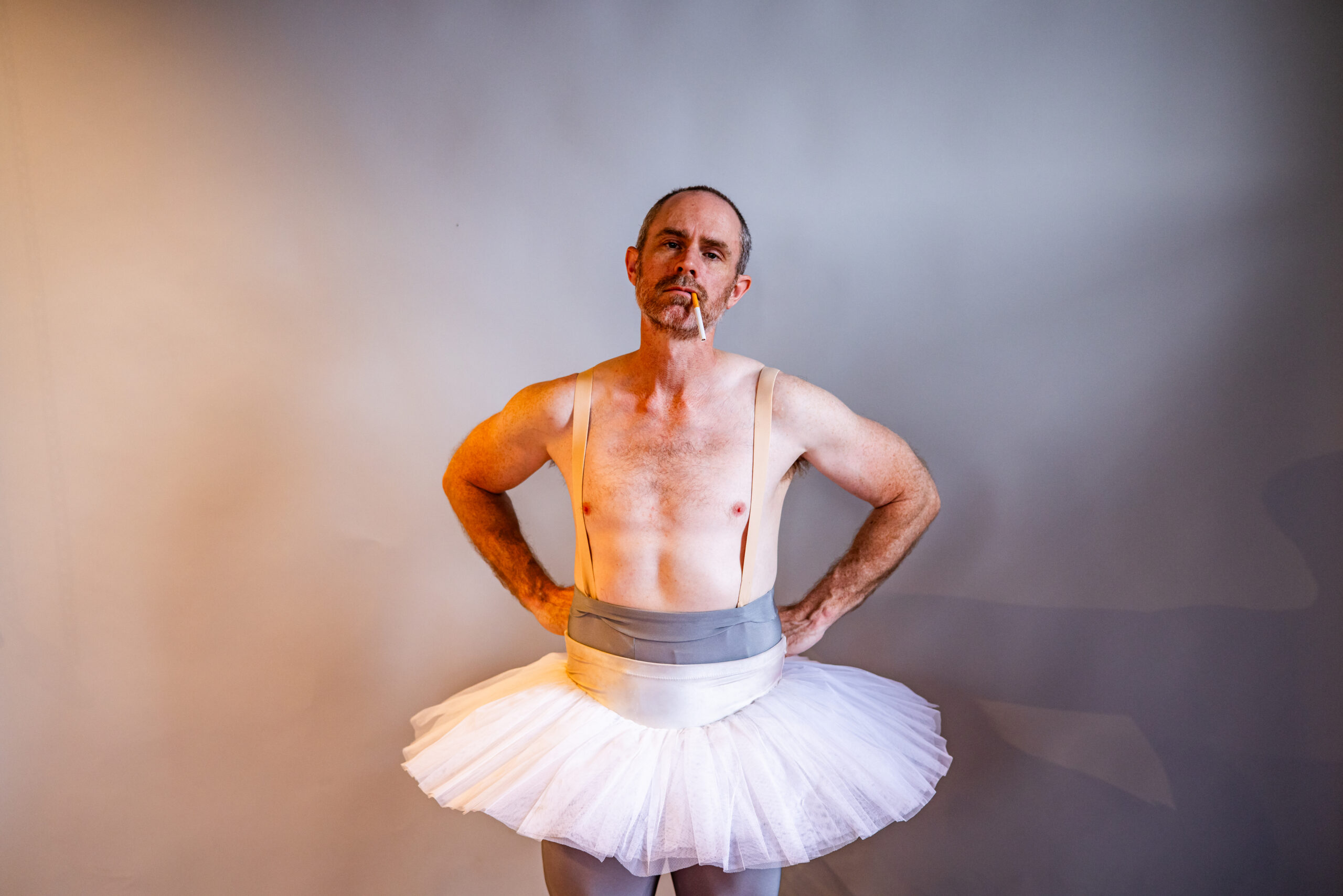

This week on Podcast 13 we welcome Philadelphia solo performer Chris Davis to Venue 13. Chris brings us the world premiere of The 40 Year Old Ballerino this August, his first new Fringe show in seven years, and his first return to Edinburgh since 2019.
Before we get to Chris, Ian and Vanesa run through what’s worth catching in June across Scotland, with Eden Festival in Moffat, Les Ballets Trockadero de Monte Carlo at the Festival Theatre and The Karate Kid The Musical all on the diary. They also have a bit of fun in an agony aunt style segment about the five types of Fringe goer, with pros, cons and shameless recommendations for our 2026 programme.
Chris then joins us for a twenty minute conversation about ballet, heartbreak, John Cusack and what it means to come back to the Fringe after a long pause. He closes the episode with a ten minute live teaser from the show itself.
This week we are skipping the Climate Change Theatre Action reading and handing that slot over to Chris for an excerpt from The 40 Year Old Ballerino.
Show Links
Chris Davis & The 40-Year-Old Ballerino
- Tickets for The 40-Year-Old Ballerino at Venue 13: https://www.venue13.com/40yearoldballerino/
- Artist Website: Link to Chris Davis’s official portfolio at realchrisdavis.com
- Artist Social Media: Links to follow Chris Davis (@OneManNutcracker) across Instagram, TikTok, Facebook, and YouTube
June Scottish Arts & Festival Picks
- Eden Festival: Tickets and lineups for the independent music and arts festival at https://edenfestival.co.uk/
- Les Ballets Trockadero de Monte Carlo: https://trockadero.org/ and Tickets for the all-male comedy ballet at the Festival Theatre via https://www.capitaltheatres.com/shows/les-ballets-trockadero-de-monte-carlo/
- The Karate Kid The Musical: Tickets for the stage adaptation at the Festival Theatre: https://www.capitaltheatres.com/shows/the-karate-kid/
Transcript
Untitled – June 7, 2026
Ian Quick recap from last time. Episode 10 was our big program reveal episode, and we shared all eleven shows coming to Venue 13 in 2026. The tickets for everything are available online. You can get them through our website and the Edfringe website. We’ve also got our crowdfunding campaign running full steam. This is to get our solar and hydrogen vegan food trailer outside the venue. We’d love your support. We will continue to put information about that in the show notes, as well as links for how to contribute to that. But without further ado, let’s get to our topic of the day. What type of fringe goer are you?
Vanesa Now, we’ve been doing some thinking about all of the very different ways people approach the fringe, and we thought it’d be fun to do this segment. Five types of fringe goer the pros and the cons and maybe our advice as well. Let’s do it. Now first up, we have the full planner. You know who you are. You probably own a color-coded spreadsheet by the end of April. Or maybe you have, you know, a lot of calendars in your phone. You do like color marked shows that you want to see you book everything in advance. You have a backup plan for the backup plan, and then you work into you walk into every venue, you’re calm and you’re on time.
Ian I’d like to say that that covers my way of approaching the fringe. Except for the.
Vanesa I would think.
Ian Except for the last point, I do not walk into every venue calm and on time. Usually, I’m rushing and trying not to expire on everybody around me, around that. So, making sure I’ve got my water and my lozenges. People who will recall our one two threes from last year of fringe advice will remember those. That’s part of it because I’m always rushing between venues. It does put you in a position where you’re never going to miss a hit show from an artist that you are familiar with, because, you know, to get it, you can get the early bird deals so you can get two for one deal. So you can make sure that you see things for things that are going to be popular. You’re going to make sure that you’re going to get those tickets that are going to be the hot tickets for it. But at the same time, when a show you’ve pre-booked turns out to be terrible, you’re stuck. You can’t really ditch it. I mean, you can leave it, but the only time I’ve ever been angry that I’ve been watching a show has been in Edinburgh because of this situation where I booked something. It looked amazing in its description and its ads, whatever. However, I got into it and then I’m sat there in the middle of it. And even if I leave, there’s so many other things that I could have been doing during that time. And I’m like, oh, the opportunity cost of doing that because I was trying too hard to see everything, you know. It also prevents you from having a lot of room for like the random thing where you, like, someone hands you a flyer or you get a recommendation. And you definitely I have in taking this approach, I have never not burned out where by the end of it, I’m like looking at a ticket. I was like, do I really is this I’m going to read the reviews before I leave the house so that I can make sure I actually want to see this. And sometimes I’ll bail on things that I’ve booked already and I like, go see something else or just be like, I just, I just can’t and you just.
Vanesa Can’t do everything.
Ian Yeah, it just is like, I, I ever did it. I did too much. You know, I can’t.
Vanesa You get fringe burnout.
Ian I did. And especially, you know, when it gets nicer or you just want to sit like sometimes you’re like, I know I paid ten, fifteen, twenty pounds for this ticket, but I just can’t, I need, I can’t go through another show. That’s not amazing.
Vanesa So there you go. And if you’re the full planner, I would say our advice is to build two empty slots a day, even if it’s just to sit, touch grass somewhere and hydrate. Edinburgh always rewards the wonder.
Ian It brings to type two, which is the free fringe. So this is where you can prioritize, pay what you can or shows that are in the free fringe, where you’re paying what you want or if you can. As you exit, generally like you can tap, most of them have taps at this point. Or you can, you know, whatever change or bills that you’re willing to part with in your pocket that you think that the show was worth, or you can, you know, sheepishly not make eye contact as you’re leaving the room because you’re like, oh, I want that, you know? This allows you to like, there are so many free fringe venues down the Cowgate. You’ve got Banshee Labyrinth, you’ve got lots and lots of comedy, primarily in in bars. It’s. Well, I guess there are people who just run through the free fringe and performers who come there regularly. Chris Davis, who will be talking to later today in this episode. Like most of his early fringe work, was in the free fringe as well. So it allows you to see as many things as you can for the most cost-effective way possible, while still giving you an opportunity to support the artists.
Vanesa Absolutely. I think it’s a great idea to see something you haven’t seen before. And I absolutely love the free fringe has its own sort of like, you know, program. So if you Google the free fringe, you will find its own dedicated section as well, which is really handy because it’s that that’s the kind of thing you want to do. You know, you have a very easily lined up program around the city where you can actually catch the free fringe shows. And the pros is that, you know, you get cheap, brilliant discovery, real community feel. And many times when I’ve seen a free fringe is when I met up with some friends. We went for some food, we went for some drinks, and then we just kind of went into a comedy show. I specifically like the ones that you see lots of, um, lots of actors. And so then, you know, if one of them wasn’t that great, you’re waiting five minutes and then you see another one. I do always encourage people to pay at least five pounds, at least ten pounds. The cons is that it used to be cash only, but now you can see more and more card machine options popping up. So I would say please do pay them even if you didn’t enjoy the show. You know, this is the artist is our time. Many of them have traveled from other places, you know, the Ireland or Australia and you know, they’ve had to pay their flights. They had to pay accommodation. They’ve probably stayed in a place that is really not very nice and you wouldn’t want to stay there. But they’re doing it for the love of the game. And I think even that in itself, you know, should be rewarded.
Ian Yeah. Our advice there is to mix your ticketed shows with free fringe shows, put them into your fringe diet, right. It’s best to have variety on your plate, you know, then you get the best of both worlds. You’ve got the high production values or people who are, you know, pre-booking things that you’re excited about. But then, you know, there’s like you’re saying such an opportunity for discovery and like low pressure, low stakes relative to the rest of the fringe while being able to like, say that you saw somebody for the first time. There’s actually, I don’t know if I brought this up on the podcast before, but I don’t know of any. We, I don’t know where our audience overlaps with Queer Eye, the Netflix series. They had a season in Las Vegas and one of their like subjects, people that they were, they didn’t make a makeover for. Right. I can’t remember his real name, but he performs as Puff the Magic Dragon. He’s in a Vegas residency. I hadn’t heard about him from years, and he’s someone who I saw multiple times in the free fringe, like a decade ago. And so I got really excited for that episode because like, I’ve, I’ve met this guy, I’ve never seen him not in a dinosaur costume, but, you know, he’d be performing on the Cowgate, and I run into him in a bar at the underbelly. Like the at the, you know, the cowshed or whatever. And so it was really like, interesting. You can see how somebody like ladders up like cuts their teeth at the free fringe and then moves them way up. And now this guy is doing like a regular Vegas residency. Like it really, you know, as, as we’ll hear from Chris, like you just do it and do it and do it. And that’s how you get better at it and it works. So it’s really important, I think, to put that into your fringe schedule, is to not sleep on the potentials of the free fringe.
Vanesa Absolutely. And then this this can be an official shout out to Puff the Magic Dragon. If you’re coming to the fringe, do pop by Venue 13. I think Ian would really like a photo with you. And then we have a type three, which would be the go with the flow punter. So this is the kind of person that books one show on the train up to Edinburgh. So they’re already on the go and they’re like, I probably should book something besides everything else on the Royal Mile after Flat White Trust the universe.
Ian Yeah. This is this is really leaving yourself up to the magic of the fringe, right? I know that every year I end up talking to somebody after the festival and they’re like, did you see this show or that show? And I’m like, I didn’t even know that it existed. And part of it is the planning that we talked about, the type of fringe cover that I am that, that I fall victim to myself as our first type. But I’ve really been trying to go more with a go with the flow approach to things. So you actually get those magical days where you run into hidden gems and you’re, you’re really leaning into the spontaneity of the fringe of like, what should I see now? Who’s going to sell me on something? And you’d be surprised at just what you end up seeing. Now, the, the challenge here is that you’re going to run into sold out shows, right? If something is doing really well and you’re like, oh, that seems really popular, you might not be able to get into it. And you sort of had this like sad sandwich idea at like in the evening because nothing food shape fits between like two panicked bookings where you’re just like, oh, what can I cram in my face right now? And you just go with what you can. So you’re sort of like, you know, you end up with like exhausted and it’s hard to pace yourself because you don’t know when everything’s going to happen. And you found out that, you know, you should have skipped something or you didn’t time something else, or you don’t know exactly how long something is, and then you’re trying to get home and you can’t get onto a bus. They’re crowded. You can’t get your train back to where you’re staying to leave town and you end up stuck.
Vanesa So, so that’s too much flow then I guess like the flow can be too much as well.
Ian It’s like white water rafting. You gotta, you gotta, you gotta constantly be like, checking what’s coming down the river so you don’t go over that waterfall.
Vanesa Absolutely. I think the advice would be to have like two anchor shows or something to ground you on at lunchtime, when at dinner, and then build everything else around that and then build some times to like, you know, have a proper amount of food, nourish, nourish the important, you know, to avoid the fringe burnout.
Ian Yeah. I think if you walk up to the box office, like at any of the venues on a given day and ask what’s great that afternoon, like trust them. And you can also do this because like, if you’re near George Square or Bristo Square that like those venues have like an outside box and they’re right next to food and lots of good food options too. So you can actually like plan your food and your sustenance and taking care of yourself and then say, what can I go do that keeps me in proximity to what I need to do? So don’t just be like, go with the flow for shows. Go with the flow. How do I take care of myself? Where does that lead me? Which brings us actually to the type four, which is the foodie, right? Which is really about booking the shows around the restaurant and what you want to eat, because there is some fantastic food throughout the festival. There are food festivals, right? Like George Square operates as a food festival just leading up to well, it’s well, they’re converting it for their shows. It’s there. There’s the foodie festival that happens on a weekend overlapping with the fringe at some point for that. And then there’s just like Edinburgh is a great place to eat too. So think about where you’re going to eat and say like, what’s close to this and there and you know, you’re going to end up with strong opinions. You’re going to get strong opinions from other people too. There’s like a coffee scene that is across the city that people are going to be like, this is where you have to get the best coffee, which you’re going to need as well. My favorite coffee place, which was temporary for the festival like years ago, was a cafe, which was like, you know, the Trump Mall that ended up with it. And then, yeah, I can’t remember the coffee was any good, but it was a memorable name for a shop as well. And planning around this, like there’s so many shows to see and they’re everywhere. But this will allow you to find that that perfect dumpling, right? The most delicious thing. Like you shouldn’t sleep.
Vanesa On a good dumpling. Yes. I guess this is like the kind of person that eats well, drinks well, you know, treats the fringe like, you know, cultural city break as well. And I guess that that happens more often than you think. Because if you’re in a family group or if you’re in a friends group, everyone has to keep fed. There’s always going to be one person in the fringe group that’s going to be thinking about food all the time. That’s usually me. But the cons is that, again, if you are in a group setting, it’s different than if you’re on your own and you can just have that sandwich at seven p m and just call it a day. But if you’re with a group of people and you’ve made some, you know, reservations at five thirty, there are three courses. There’s wine, you’re having a chat. It’s very easy to miss a show. You could miss your next booking because you were having a chat. And then, you know, by the time everyone gets up, you pay, you know, the restaurant visit will overrun and then you will miss a show. And that is a con because that’s like money wasted, its plans ruined. And then someone can like, be feeling a bit resentful.
Ian Yeah. You know, I think our advice would be like, plan eating. Like you plan your shows, keep it, keep an eye out for our new hydrogen and solar vegan food trailer Venue 13 like easy to see our shows if you’re there, have something in between. A couple of pro tips as you’re planning this though. One, a lot of places, at least in the city center, don’t take reservations during the festival. Uh, there’s a few that do, especially if you are looking for a group, make sure that you’re looking at that. It’s going to limit your options though, but the turnover is so high and they’re going to be full so much that they’re not worried about planning ahead. So know that you’re going to run into issues with that except for in specific places. So think ahead there and in treating and avoiding your fringe burnout. Keep in mind when you get to drink things out of a glass, when you get to eat things with a knife and fork, it is very easy. If you’re just in the festival like flow to like eat things out of on paper plates, out of like wrapped up takeaway containers with like small, easy to break sporks like sometimes it treat yourself. It’s important to do that during the festival.
Vanesa Absolutely. I mean, this reminds me of, do you remember there was a time and I’ve not seen it that much lately. I feel like we’re over that now as a society, but there was a time where everything would come on a slab or like a slate slab, and I was like, I just want a plate. and everything was in the slates and that there was a very strong analogy that everything like all the theater and all the artist shows were happening on this random things like in a football pitch, in a, in a park, in a basement and in a terrace. And this was that I, I saw a theater show and then someone said to me where I was like, in a theater. And they’re like, what? And this is something I kind of feel like that’s something that. Chris also spoke as well, that when he did the, the free fringe, you know, everything in Edinburgh turns into a venue and it has its pros and it has its cons. It’s very good that you get to actually have that access to all the art that is going to be available to you. But at the same time, a lot of that art comes at a cost of like not being properly teched, you know, not, not, not the correct technology, not the correct lighting, but, you know, you’re doing those trades because you actually want to see the show and you want to, you know, ingest that type of that, that, that cultural shock and the bit of art that, you know, it’s very much needed and it’s like you’re fixed for the year. But no, this was definitely when you said, make sure you eat something of an actual glass and plates. I am very glad that I’ve not seen many things served on slates.
Ian The other thing to add there is like, make sure you eat some vegetables and like fresh vegetables. Like I know that we have a vegan menu, but we can be just as guilty. Like we have a relationship with considerate, which is vegan donuts. We sell vegan ice cream. There are days when that is my primary diet. I’m not gonna I’m not gonna throw shade on anybody else. I know there are days that I’ve survived on on that. It’s important also to eat like vegetables, fresh vegetables and tender especially. And it’s very easy not to during the festival. So you sometimes have to make a conscious effort, you know, grab a piece of fruit. At least.
Vanesa It’s true. I mean, in your day-to-day life, you could ask podcast thirteen advocating for your five a day. And then about five days. Here’s type five the half and half. So that’s probably my favorite. So it’s kind of like this is a person that is half booked, half open. And it’s kind of like a seasoned festival goers. So they just know they’ve lived it all. They’ve done the extremes and they know what to lock in and what to leave to chance. And they will take the flyer if the energy of the person is right. For many, many years at the fringe, I’ve actually printed myself a badge. And it was a big badge. It was the size of a paper plate. And I said, I will not take your flyer if you’re not smiling. And that was that. Like, if someone gave me a bad mood flyer, I wasn’t taking any that kind of energy in my life. But and I think that is a big thing is like, if you feel like it’s show might be worth doing it, take the flyer, take the risk, but you can because you are half open, you know, you’re half booked. So that’s a, that’s an adventure. I like that.
Ian Yeah. That’s, that’s what I aspire to. I’ve yet to get there. I know that I’ve tried to. The book has become so overwhelming, so I’ll flip through it. But whereas I used to try and put everything that I wanted to see be like, here are some key things. Maybe some people that I’ve seen before shows that do a really good job of like sounding compelling and lick them up a bit. But I’m like, then I want to find out. I want like recommendations from people that I talk to. If I know somebody who’s working on something or something like that, I want to find out about that. You never know who’s going to be in town, especially if you’re working there. But this is really that Goldilocks of the fringe goer, right? Right there in the sweet spot that gets to see the must sees, or at least you know as much of them as they can, but always gets to discover something new like, and actually builds in sleep. Like is actually able to, to sleep. It’s not trying to go too hard, right? There are challenges like this is this is best done if you have a few days, right? It’s hard to, to think if you’re there for a day or two, completely understand booking. Every waking moment going into something. But if you have a few days, if you can take a bit of time, this is a great way to do. But it can also lead to fatigue as well. You know, you could end up double booking or really want to see something. You realize you get a flyer for something you’re excited about, and it is playing at the same time that you’ve got something pre-booked and you’re leaving the next day and you’re really torn, or they’re they’re leaving the next day, right? So, but that’s the case. There are too many shows to physically be able to see them all anyway. So this is this is the, this is the person who has that ability to like, have that Zen balance idea that it’s like, I can’t see everything that I want to see. And I’m okay with that.
Vanesa Very good. I believe that our advice would be that all of this is the format that we recommend the most to people. This is kind of we want three to four shows booked a day, one or two open slots, snacks in the bag. So I would say, Ian, are we safe to say that you are the planner I am.
Ian I’m the planner. I aspire to the half and half. But like, maybe after twenty years, I’ll get there. It’s taken a long time to get there. How about you?
Vanesa I think so, I am dear, dear listener. I am in a very privileged position because I always tend to actually go and see some shows with Ian, who is the planner. So I am the kind of the alternative, like The Passenger Princess of the fringe, because Ian will do all the hard work. He will find, he will do the research, he’ll find the things, and then I’m going to be the go with the flow and a bit of a foodie. I’d be like, oh, I kind of want to have some food. Or if I go out to a friend to meet my friends, I am more excited about meeting my friends. And then I feel like anything else that comes any, any free shows that we see is kind of like just an add on. But I’m just glad that I met my friends. We had some food, we had some drinks, and we had a good time.
Ian Yeah, I do, I do enjoy your trust in my selection. That’s not trust in quality. I want listeners to know this is not. Vanessa does not necessarily trust me to always pick good shows or the things that. Like and good that she wants to see is always interesting and it always leads to an interesting conversation. And I do love having the conversation afterwards where either we appreciate the show in different ways, or like, I just made a bad decision and we can like dish about it over, over, like, you know, we’ll go into the garden and pick up something to eat and be like.
Vanesa That was sh*t.
Ian Yeah, I was trying to before I tried to be very polite about it, but yes.
Vanesa Sorry, is it, is it a friend? If you haven’t seen a bad show, it’s not.
Ian No, no. Like it’s the only place that I’ve ever angry this show.
Vanesa I was so unsatisfied as an artist, you know, experiencing a friendship. I’ve not seen a bad show. I feel like something’s off. Something’s not right. Listeners, tell us which type you are. email us at podcast at venue dot com with your answer or comment on our socials and your fringe. We really want to know what type of fringe you are. On this episode, we want to welcome Chris Davis to Venue 13 with his new show, The 40-Year-Old Ballerino. This is one of those shows that immediately felt right for Benny, thirteen, a solo performer with a long fringe history, a real personal story underneath the comedy, and a show that really does speak for itself.
Ian Solo storytelling has become one of the strongest currents at the fringe over the past few years, and Chris’s trajectory of success form sits right at the heart of it.
Vanesa Chris has a back catalogue stretching across more than a decade of touring, and the four-star quote from the list calling his works the kind of innovative spirit the fringe was created to showcase.
Ian Edinburgh has certainly missed his talent and twenty thirteen. We’re excited to welcome him back with The 40-Year-Old Ballerino this August.
Vanesa Let’s bring him in. Chris, welcome to podcast our team.
Ian It’s lovely to have you with us.
Chris Davis I’m super excited to be here and super excited to return to Edinburgh this year.
Ian Yeah. For people who don’t know your fringe back catalogue, can you give us sort of the short version? Tell us about your work and how your relationship with Edinburgh and the fringe started?
Chris Davis Yeah, absolutely. So Edinburgh definitely changed my whole career. Um, I came first in twenty fourteen and I honestly knew very little about the festival. I did not know it was the world’s biggest festival. I didn’t know it was thousands of people. And so I went and performed the show with no expectations and not knowing anything. And of course, that show did really well. And it was my first year and I was like, oh, this is amazing. So I kept coming back year after year after that, trying to build on that momentum. And I ended up doing that show, which was called Drunk Lion. I did that for three years total between twenty fourteen and twenty nineteen while doing other shows, and the reason I kept doing it was because it became very popular and just very easy to fill houses. And I did it through the free fringe, and I took all the skills I learned in Edinburgh, and I really brought them back to my life in the United States. It really just helped me as a producer and performer and as a writer. So it’s a place where I really have workshopped almost all my pieces, and this is the latest piece to take there and watch it go through the Edinburgh Gauntlet. You know, you start with a show in the beginning and then twenty two shows later, you’re like, wow, this show has performance wise, even script wise. It just elevates. And so, I mean, I think that’s one of the best opportunities you. You go to Edinburgh with a show and you leave with something no matter what. Usually, you know, at a much higher level, a much more improved show and that I. And you learn, you know, you you survive? Trial by fire. Right? Like from drunk Scottish people yelling to you to. Yes. That happened so many times to me. I did a lot of late shows. Um, but like you learn how to deal with hecklers and the chaos and all that and how to separate yourself from three thousand five hundred shows, which is the challenge. And that’s fun, you know? You do podcasts, you do everything you can because you need to, to somehow drive people to your show when you’re there.
Vanesa Absolutely. And you know, you are now you’re a fringe regular. You’ve you’ve done it. You live for six years in a row. And now you’re returning this year with The 40-Year-Old Ballerino. And now can you tell us how does that feel and what can the audience expect? Like for what you’re just saying? Like, basically it feels like the show is a live piece of work that just evolves throughout the month. Can you tell us a bit more about what to expect on the other side, like when we are attending your show?
Chris Davis Yeah, I think, you know, I’m not I don’t believe there’s a magic formula to Edinburgh’s solo shows. However, There is a magic formula to Edinburgh solo shows, meaning there are certain qualities that I’ve learned from seeing shows there and really I tend like over thirty shows every time I was at the festival. And so in a sense, The 40-Year-Old Ballerino, it takes all the tricks that I’ve learned, all the different techniques that I’ve learned, all the writing stuff that I’ve learned, and I think packages it together in a way that I’m super excited to share because I’ve never had, you know, a real venue when I’ve done shows there. I’ve mostly performed in pubs, I’ve performed in a yurt in Three Sisters one year, where there’s often stag parties outside screaming during football matches. I was in the middle of the day. I performed in an attic in the counting House. I performed in the basement theatre of newsroom pub. I performed at a hotel in twenty nineteen off George Street, so I. And I loved all those experiences, but to. To be able to go there and have a dedicated venue with lighting, with tech. I’ve never had that amount of support and production value behind the show, so in this sense, this show, I believe, will be like a fully realized version of what I want, and that’s something I’ve never been able to do before. So that’s what is a big difference for me. And it’s a big risk, but I think it’s worth it. And the show itself uses all these techniques through storytelling, through it’s very personal show, through my own personal life, with movement, with physical movement, with ballet. You know, during the show, I basically do an entire ballet barre class while telling you about how I love ballet, but the ballet actually informs the words that are coming out of my mouth. The two are inner, they are connected. And so I think this merging of like physical theater with storytelling, with sort of stand up comedy, with all these things, that’s what I’m most excited about. So is this amalgamation. And I really hope to get some of the dance fans in Edinburgh, because I know they’re there and I know the dance scene, you know, is there, and I think it’ll be cool to connect with them and just sort of try to bring in that audience and that they’ll really connect with this show. But this show is ultimately for everyone. It is a show that is about investing in yourself and about changing your own life. And that is something that everyone can do and that all of us have opportunities to do, whether we take advantage of them or not. I think people have really connected with that aspect of the show.
Ian That’s great. Like, I mean, first of all, as somebody who is has crossed that boundary myself, you know, you’ve got this premise then taking up ballet at at forty, which be on the other side of that myself is a really impressive maybe having the bar in the in the venue will inspire me to. But like coming as a substitute for, you know, other other vices ranging from the, like The the drugs and alcohol side of things up through like, you know, media consumption, Modern Family reruns and John Cusack movies. It seems like very specific. I, I myself can relate to a lot of this, but like, how much is this from like your experience? How can you, can you talk a little bit about like channeling that experience of taking up ballet, like into this new passion?
Chris Davis Yeah. This is, you know, it’s a, it’s a memoir play. It’s almost entirely true. Um, everything I say in the play is basically true. I do take some liberties with timelines. The play talks about a relationship with a ballet dancer. Who is the person that got me first into ballet. So like, you know, obviously at forty, you don’t always just jump into something like that. But I had been living with this person and watching them do ballet. And eventually I was I started to say, oh, I should try it once. And I discovered quickly that I really loved it. And then all of a sudden, even though that relationship ended, I continued my relationship with ballet, which is really interesting when you, you know, you, you have relationships with people. Sometimes you can take things from them. And in this case, you know, you take the art of ballet and then it eventually becomes yours. And now it’s beyond that person. Um, now it is my practice and I take it very seriously. I take class four to five times a week. I’ve been taking at that pace for three years. So you can imagine it’s completely changed my life. I changed my body physically. It’s changed my mind. It’s changed pretty much everything. And, you know, eventually it becomes a habit and then it becomes your community and then it becomes the people you want to be around. And then and this is if you really love it. And I don’t even know exactly why I love it, but I think there’s like a sort of peace you get from it. You know, your thoughts don’t run so much. Maybe if you have like a fast brain or something, you kind of silences your brain for a second while you’re practicing. And so similar to drugs and alcohol, that’s another reason why people do those things. You know, you drink because it relaxes you. You you do drugs because it silences things in your brain. So I actually see a ton of connection through this sort of like these addictions that people have and that I had to I quit drinking three or four years ago and this will be my first Edinburgh, not not drinking alcohol. I feel fortunate because this all could have like kind of fallen apart, but in a sense, like because I stayed with the ballet, it means also the show keeps changing because my ballet practice gets better. There’s dances in the show. I get better at doing these dances. So there’s no two shows are not alike. I’ve been working on this show for three years. I’ve had little iterations here and there, and this is the final thing, and this is actually the best I’ve been at ballet. And so when I first started this, I really could not do it. Like I could not perform the show very well. It was very hard breath wise. I didn’t have the stamina. One of those shows I always think about is by Richard Gadd. It’s the one with the monkey that chases him on the treadmill. What I loved about it was the physical feat of him running the whole show while this monkey, which was his trauma chasing him the whole show. Richard Gadd does not stop running for an hour straight while speaking an entire monologue. So in a sense, this is sort of stealing a little bit from that where it’s like, okay, can I do this ballet while speaking while doing this? And it is very hard. And so there’s a little bit of a physical feat to the show, which I think is fun for the audience.
Ian Can he do.
Chris Davis It? Can you do it?
Vanesa Yeah. And I think this is also like you chose the ballet and it is extremely precise. And it definitely is something that, you know, pushes you to actually get better. And it just sort of reminds me of my, my main experience that I have with, ballet dancers was a few years ago, about five years ago now, and I was very close friends with someone in the Scottish Ballet, and he invited me and a group of friends to the opening of The Nutcracker. And there was an emergency, and the leading lady who was dancing couldn’t make it. And it was kind of like that happened sort of like two days, two days before. And it was a big, big stress. And they had to fly this girl from New Zealand. And because they actually had to, they have this like world network connection of who can actually step in as short notice that knows it. And because every ballet, you know, organization has its own sort of little flair, they had to find the most likely one that could actually fit within the, you know, this, this sort of schedule that they had and deliver. And that night we all went out with the whole cast. And I remember speaking to this girl and I said, were you nervous? Were you like, how did you manage this? You know? And she’s like, I was just told. And it was an immediate yes, I just jumped on this and, you know, on this plane and she goes, and, you know, we were all drinking. They were drinking champagne and she wasn’t drinking. And then she actually did also tell me that I cannot drink because if I’m performing, it’s going to take too much out of me. And she’s like, all I can do right now is, you know, have lots of water, high protein. And she goes, I just need to do my weight training and my cardio to keep up with this. And she had to have like a full month, you know, on this, on this production. So that really remembered like kind of resonates with what you said about the discipline that this, this, um, you know, art requires of someone.
Chris Davis Yeah, absolutely. And I think especially at an older age, like that is intimidating. I’ve always been very afraid of injury because, you know, that would be the end of my show in a sense. Like I have to be able to physically do this stuff. So I’m very cautious about these things and very careful about how I treat my body, and a lot more so than I was in the past. In my first six years in Edinburgh, I’d say that is a different iteration of a person. So really, when I come back this year, I feel like I’m a new performer. Like I’m a different type of performer. Not that I was bad before, but I’m different now. And I think I’m better now. I know I’m better now. But you know, I, I, I still have respect for that guy from the past. And he was very fun. And I’m still fun, but he’s different how I approach these things. Um, and I look forward to sort of testing all those things in the Edinburgh environment, which, you know, I’ve had shows there go incredibly well and I’ve had shows there struggle. And so I’ve been on both sides of that coin. Yes.
Ian Someone who’s been going with shows, I’ve never been a performer. I am not a performer. It’s not something I’m interested in doing, but I’ve done. I do pretty much anything else, especially with the show. But I’ve been going since two thousand and eight and people wondering like, okay, so what makes a good show? But yeah, the like trying to have a, like any sort of idea of, of, of what you’re getting into is, is kind of like it’s an impossible task. And with all the shows that you’ve, you’ve written and toured and brought to Edinburgh before, like you have a, have a like a catalogue of them between Drunk Lion and One Man, Apocalypse Now, silence of the lambs, etc., and One Man Nutcracker. You have not brought that one, but you’ve been touring that to like. But is there a similarity between like, is, is is this a culmination? What is the continuity? Is is there an expanded Chris Davis universe in which these exist?
Chris Davis Is the shows does always have like a core part, like a core heart to it, something like a message of some sort. And, you know, that message is that, hey, you can not only change yourself and your body, but change your relationship to other people and how other people treat you and how you treat other people. And so that is a core value that the relationship with yourself and the world itself. And that’s new. You know, that’s something that I didn’t think about before so much. I sort of just was in the present, you know? I’d say the pandemic had a huge impact on me because it stopped me from going to Edinburgh. I was supposed to go there in twenty twenty. I was going every year. I had no plans to ever to stop. And that since it’s been seven years since I’ve been back and it was a big break, it was necessary break for me. It was very good. I’m happy to be back. I’m excited to be back. And so these shows like they’ve all, you know, you every time you go through Edinburgh, you take a new show, you learn something. You. And you know, I’ve learned the most from watching other people’s shows, to be honest. Like, yes, it was great doing my show, but seeing shows like Richard Gadd, there’s a million other performers and I’m gonna try to name everyone. I see so many. Those shows really affected my own writing, how I approached theater. I’m thinking of a show in twenty fourteen called Beowulf was a solo show, very popular. It just taught me the importance of like, storytelling and staying with your audience. Very simple lessons. Um, it’s not, it wasn’t even like a mind blowing show in that sense of spectacle was a beautiful show. So yeah, I think Edinburgh a lot. So in a sense, you know, The return is also like a thank you to the city itself. You know, the, the festival is so messy in a sense for the locals, for the people in the city. And I know people love it. People hate it. People are neutral. There’s just all different opinions. You have all the people from London coming in, there’s friction and all that, but at the end of the day, it is a celebration of theatre and like gathering. And the biggest for English speakers in the world, you can’t really replace that. Um, and the energy, as you know, is like you try, I try to describe to people what the energy is like, because that’s really the thing that sticks with me there is that you’re on the streets and you’re just sort of in a whirlwind of performance, and there’s no other place I’ve ever been that has gotten anywhere close to it.
Ian The different frictions and the different way that people react to it. Sometimes that’s the same person, like hour to hour or two that it’s like, I hate it here. I love it here.
Chris Davis You know, hate and love. Same coin. Right? So if they do hate it, that also just means they really love it. So because it is a party in your backyard.
Vanesa So you’re coming over from Philadelphia. Can you tell us what do you miss about Edinburgh? Because it’s not like you’ve come once. You’ve come more than once. And I always feel like when I travel somewhere for more than one time, I start to enjoy things that could be products, that could be experiences, that could be parts of a city that when I go back, I look forward to specifically now with, um, with our show and with some of the academic work that we do with Ian. We’ve been to Prague a couple of times now, and I know that we’re going next year again. And I’m already, because I’ve been to a couple of times, I am already looking forward to some bits of Prague that grown on me that I know that I can get, you know, that particular coffee in that place or that particular thing in that other place. Do you have something like that with Edinburgh?
Chris Davis Definitely. And I, by the way, I would love to go to Prague.
Ian What’s true?
Chris Davis I’ve never been to Prague. That one sounds amazing. That’s something I would love to do. Um, Edinburgh. I mean, you know, I will say so. I was there twenty fourteen, twenty nineteen. That’s pre-pandemic. So in a sense, I do feel like maybe I won’t know this city in the same way that I did. Like what changes have occurred. I’m curious, but in that period of time that I was there, you know, the audiences that you get, whether it’s five people or fifty people or in general, very generous, uh, very, you know, this idea, like everyone was pretty cool and, and kind overall. And, you know, people that are going to see live theater and taking a chance on a show they don’t know anything about, especially when I was doing smaller venues and stuff. They’re just sort of down to see whatever, you know, whether it was the greatest show in the world or not. They’re just here, you know, they wanted something fun. And I was doing Free Fringe, which is a sort of different clientele. I think the paid fringe, I hate fringe people tend to be a bit more serious about because they have to purchase a ticket, but also the diversity of the audiences. You know, when I did Drunk Lion, I had people from Spain, from Germany, from Japan, from Hungary, and that show was an international show because it had Spanish in it, so people just flocked to it. Every Spanish speaker in Edinburgh seemed to find that show, and that was really cool to like, tap into an international audience and like, you know, you have all of Europe right there. And at least when you’re there, it feels like a lot of people do come in from all these places. And yeah, I mean, the energy again, the performer energy, you have to bring it. Obviously, it’s I’ve seen people, we all know people that have crashed out in Edinburgh and have not had a great time. And that’s, you know, that’s that’s on you. You have to bring the energy and match the energy of the city, which is very daunting for, for some people because it is twenty four over seven and it’s every it’s the entire month. But for me, that was never a problem. That’s not an issue. It’s something that like, yeah, I, I find myself very energized by it.
Ian You make a good point there too also. And it’ll be interesting. Like I, I also drink a lot less than when I started doing Edinburgh. You just get to a point in your life where it’s just not quite as fun. The next day.
Vanesa I drink the same, by the way. Like I know everybody’s like, oh, I’m Elizabeth and I’m from Scotland. I drink the same. I continue to do. So.
Ian It changes. It changes. Like your relationship with the city over time. It’ll be interesting. It’ll be interesting to hear what your reaction is to the city, because it is something that, like now that I’ve been back for a few years myself. I started coming back in twenty twenty three. It’s become familiar again, but there were a lot of at the same time that it’s like an ancient and medieval city. So like the architecture doesn’t change that much. Like you still generally know where things are, but the like the shops, like the population changed over things that I went to and, uh, like cafes that I went to all the time and were favourites had like moved or closed or been replaced with other things. And you know, how much it changes and how little it changes. Actually, it was really interesting to me in, in my first trip back, you know, the, on the, on the subject of, you know, things that change the show argues that change is always possible no matter what your age. So to leave the audience with this message, what would you say to anyone over forty who was thinking about changing their life around.
Chris Davis Well, and I will say this, uh, I’ve done this show for a few times in the United States. I do one man Nutcracker, which uses a lot of ballet. I have multiple messages from people that have seen the show that talk about specifically this, and they say, hey, you know, I saw your show and I’m sixty something years old and I decided to try ballet class. And I love it. And I, I’m not joking. There’s multiple messages like that of not just forty. I’m talking about, you know, honestly, in a weird way, people in their sixties and 70s seem to be more these days more willing to embrace change than people in their forties, which I don’t know what that’s about. But, you know, so I’ve always been just like the themes of the show resonate enough to get people to do that. And they usually they’re just thankful and they say, hey, you inspired me to try this thing I never thought I would do. And I’ve actually seen some of these people in my own ballet class, because here in Philadelphia, I’ll tell them exactly where I go. I say, you can go this time. And they’ve shown up and it’s often they’ve been in the older category of of fifties and 60s. And, you know, life can get a little, you know, boring and routine at times. So it’s just good to remember that. Yeah. You actually can do anything you want. Like you really can’t. You can, you can go and take any sort of dance class you want. And even when you show up, it could be tango or whatever. No one’s gonna make fun of you. That’s all. Like, you know, we have all this grade school stuff in our heads where it’s like, everyone’s looking at us, we feel like an idiot. We’re. And, you know, you can feel all those things. But the reality is when you show up to these places, and I’ve felt that so many times, contemporary dance stuff like that, no one cares what you’re doing at all. Just like, and you realize, oh, actually, I can just do this and I can do it badly. Like, I don’t have to do this well. But when you start ballet, you’re only going to do it that quote unquote badly. But like as a ballet dancer will tell you, even though they’re the top of their field, they feel the same way, like they still struggle with and they feel it, you know? You can see the most amazing dancer and they’ll be like, oh, that was horrible. I didn’t do it. And you’re like, what are you talking about? It was so beautiful. But it’s like there’s ballet in particular, just like shows and writing. There’s no end to perfection, you know? You never complete the task. You’re never gonna get to be the ultimate ballerina. You’re always in process and like, that’s our life. Our life is in process. That is the point, right? Like to find things in life that scare you and to try to do them. That makes Monday feel a lot more exciting. It’s about relationships and how we treat each other and how people treat us. I use the metaphor of Coppelia, which is about a guy who falls in love with a doll. It’s a real ballet, and it’s like. And so I talk about that and how he’s sort of like he creates the doll into his own, you know, into what he wants. This is everything he wants, but the person is not even real. He doesn’t know that, but he’s created the image of a person, the fantasy of a person. They’re not actually a real person, but it doesn’t matter because in his mind, they’re real. And we do the same thing with our relationships, our romantic relationships. We’re often will create a fantasy of a person. And then when they bring their real life stuff, we’re like, it can break that fantasy. It can shatter it, it can end the relationship. And I think so I try to talk about that too, in my own relationship with this person, how we both do it to each other in different ways. And it’s not like an indictment of this person where I just sort of I’ve been unpacking that. And another part of this show that’s important is like, therapy is a big part of the show. My therapist is in it as a character and talking about these things, and I’ve learned a lot from that, you know, just from going through that process. I also so I started ballet in my forties. I also started therapy in my forties. And I don’t, you know, I had never really done it before. And so those two are also kind of actually interlinked. And it’s in the show itself, like the therapist is sort of a character that talks about certain things and ideas that I’ve always either never thought about or just struggled with. And for me, people connect with that. You know, I think when you get to your forties too, you’re like, you start looking at your life in a different way and you see what you’ve done and you see the decisions, you’ve seen the consequences of your decisions. And that is actually a privilege. That’s something I couldn’t see in my twenties and thirties at all. And I feel like much more clear about, oh, so that’s what happens if you do this for a long time and not everyone gets that. So I am really excited about that because I feel like it has like the, the heart of what a solid Edinburgh solo show means. And to me, I was like, hopefully audiences see it, they tell people and that, you know, brings in a natural because I do think it’ll be something different than anything else in the fringe. You know, no one else is doing ballet and doing it like I know that. And that’s awesome because, you know, as you know, separating yourself from three thousand five hundred shows where half of it is someone talking about their personal life and their story or whatever, it’s just really helpful to be like, no, this show is different. Like, this is going to be a different experience for you. It’s not going to be the same as.
Ian Yeah, I think, I think one of the things that, that that gives that away, if people don’t realize that it’s actually the title, this is something that I think about a lot that perhaps like one of the things that I’ve learned over time through, through doing so many, being involved with so many Edinburgh shows, is one a compelling title, especially if it tells people what they do on the tent. Like people are literally going to see it, says what it is on it, and people should believe that what they’re going to see it. Yes, either it has to be compelling for some reason, or tell someone exactly what they’re getting into the show and I chased this high. The show that I was involved with on like the producing side, that was the the easiest to promote ever, was an all male production of the Buckeye. Like I barely had to do anything to like people knew exactly what I was going to be. The tagline was the title and it found its audience. Yeah. And so I, that’s one of the things that I’m excited about this. And I think that you’re talking to two people who also like have been through multiple phases of, of career and finding things. It’s like, yeah, let’s, let’s try it, let’s, let’s get this venue started again. So I think that it’s really going to fit in with what we’re doing. And in our last episode, we were talking through the entire season and you mentioned sixty year olds, like we have a solo show from a company here in Toronto called, uh, well, the show is called Sister Sophia Kicks the Habit and the company as a universe over sixty. And so it’s like, we’ve got, we’ve got people working across all sorts of areas. Another sort of veteran performer has never done Edinburgh before. So it’d be interesting to, to take a look at these two solo shows that we have with, with veteran performers like finding their place within the festival this time around. So thank you so much for that. I’m really looking. I’m really looking forward to it. I’m going to protect that bar because it’s important for the show. But see me getting inspired for it.
Vanesa From my side, I can say that that’s been truly inspirational. And I’ve just completed my beginner salsa and I will move on to intermediate salsa. And this is something that’s actually genuinely given me lots of joy that I could accomplish that. And I think this, this show has a level more the level of messages. And I really am really looking forward to it. So Chris, thank you so much for joining us. For the audience, The 40-Year-Old Ballerino placed at twenty thirteen from the Seventh, the twenty eighth of August at 2:45 every day except Mondays. Tickets are fifteen pounds full and ten concessions, with a two for one. On Tuesday eleventh of August. And we have the fringe friends as well, so you can book through twenty thirteen and we will leave all the links in the description.
Ian And if you want to keep up with Chris between now and August, you can follow him on Instagram, TikTok, Facebook, and YouTube, typically at One Man Nutcracker. We’ll put the links to all of that. It’s on the show page too, so you should just go there and get tickets. But it will also be in the notes for this if you come to see the show notes first. You can also check out all of his work through real Chris Davis dot com, which will also be linked as well.
Vanesa As parts of the podcast are doing tradition, we invite every guest artist to share a taste. What audiences will see at Venue 13 this August.
Ian So without any further setup from us, here’s Chris Davis with a teaser from The 40-Year-Old Ballerino. Chris, over to you.
Chris Davis This piece is called the The 40-Year-Old Ballerino. I’m not forty, though. I’m forty four and a quarter. I don’t know if you can tell from where you’re sitting, but I have really great ballet feet. One time my ballet teacher stopped the class and said, look at those feet. They were my feet. I was looking around for someone else’s feet. But then I saw everyone was looking at my feet. I didn’t see anything though. I just saw feet. Now I look at other people’s feet and I think, what a shame what happened to be born like that. Feet like that. Can’t imagine. Must be hard. I’ve been going to ballet class about five to six times a week for the past few years. That’s what I do every night. I can’t stop. I’m addicted. People say it’s healthy. It fills something. It fills the time. I think it fills the hole of, like, life. That’s why I do it. But now I’ve gone too far. Now it’s not a choice. Now it’s what I have to do. It’s who I am. I used to do other things before that did this. But they were bad. Like drugs or alcohol or more drugs. Bad things. But I did them with the same dogged discipline. It’s just that this time it’s good. That’s the only difference. But for me it’s the same. It fills the hole. That’s it. I dated a ballet dancer for years. That’s how I got into it. I remember her always doing ballet, and I was always sitting on the couch watching her do ballet. I didn’t do it, though. I was just there. I didn’t think I could like, it wasn’t for me. She dances in Japan now. I think the Japanese, they probably love her. They probably, like, go crazy. Wow wow wow wow wow wow. I imagine they’re screaming. You are so good. Coz I’m from the nineties. I have completely unrealistic romantic fantasies. I think maybe I dance so much ballet I become a pro at forty years old, and then I audition for a company and she’s in the company. She is my ex who is a ballet dancer, and I get into the same company and the director says, H, this is your new partner and it’s me. And I’m all like, ballet swole like huge calves, arms flexible. I’m a completely transformed person. My legs are like pillars. I’m sinewy. And she says, Chris, is that you? And my voice is even deeper now. And I say, yes, it’s fucking me. Look. I’ve changed. And then the music montage moments, we reconnect, we go horseback riding in Japan, watch a movie in Japanese, play a pinball machine. Akira. And then the thing at the fair on the boardwalk with the claw. It’s a big stuffed teddy bear in ballet shoes. And I win it, or she wins it. And we laugh over fries with Cheez Whiz, Japanese whiz. And then the finale, our big performance at a big stage with a lot of seats, big seats and big people. Important people. And at first they’re like, I don’t know. But then they see our chemistry and they’re like, wow, we wow the audience. Everyone says, wow, wow, wow, wow, wow. We are the best duo ever. Roses and applause. And the reporters say, now that’s a love story. That’s a real love story. And I wipe a tear away and I say, yes, it is. We are love personified, clearly. And I love that fantasy. It’s so beautiful. I don’t care that it’s bullshit, that it’s hackneyed, played out, cliche and probably patriarchal. I was born in nineteen eighty two. I’m still holding a radio above my head. It’s still raining. That shit is inside me. I’ve tried to get it out. I’ve been reading bell hooks. All about love, the will to change. I’ve tried to get it out. But you can’t cut out everything. Some things just linger. Some things are just you. It’s deep in an unhealthy relationship towards romantic idealization. That’s me. I grew up in the nineties, and I watched way too much TV. End of excerpt.
Ian We’re not quite to August yet. We will be talking to all of our artists, but let’s talk a little bit about what’s on in June if you’re in Scotland. This month there’s a lot to look forward to, and we’ve picked three that we’re particularly excited about.
Vanesa Now first up is Eden Festival, running from the eleventh to the fourteenth of June at Wray Hills Meadows, just outside Moffat in Dumfries and Galloway. Now this is one of Scotland’s loveliest independent music and arts festival. You should expect about almost a week, four days of music across multiple stages with strong family programming and a lot of interactive arts, woodland areas, circus and cabaret alongside the headline acts. The vibe is more closer to a boutique camping weekend. So it’s very family focused and it’s really wholesome. It’s great for first time festival goers and for families, and tickets and lineups are at festival dot co dot UK. Ian, have you ever made it down to Watford for Ethan or is this on your list?
Ian It’s on my list, but I’ve never been able to make it like it’s been sometimes be hard to pull myself out of Edinburgh. We’ve got so much work in there, but it has been something I’ve been looking at for a while. I’ve got your. You’ve mentioned it to me and I’ve got other friends in town who really rely on it as, as something that’s like a nice, like way to start the season before they’re really getting into like, if they’re working the festival or trying to get out of town for the festival before they’re like making those plans. It’s like a great space away from that to be able to like, enjoy yourself. It’s the calm before the storm. And so it’s always been something that that I’d like to do, but because I’m stuck in Edinburgh most of the time, whenever I’m over, there are also things that you can see in town. And this is not to say that you’re stuck seeing them. They are things that we are excited about. We’ve got Les Ballets Trockadero de Monte Carlo who are back at the Festival Theatre, and that’s going to be on the sixteenth and seventeenth of June. They’re actually a US company founded in New York in nineteen seventy four. It’s an all male comedy ballet company that has been parodying and honoring the classical form for over fifty years. So a great tie in to the shows that we’re bringing up as well. So if you think, yeah, I’m going to check out Chris, this is a good one for you to check out ahead of time in June. So, you know, same pointe shoes, tutus, Swan Lake, a whole lot performed a very serious technique, but very silly faces. It’s a perfect double bill, as we said. So you can get those tickets at Capital theatres dot com. You know, I feel like the universe is sending us a sign with all this ballet content in our diary at the moment.
Vanesa Well, I think that this is a very good curated podcast episode because I feel like, well, if you’re going to get excited about August and I would want you to, you know, get something to do this month as well. And you can compare, I genuinely do believe that anything that is like interacts with ballet and the arts. And also, you know, you can say this is like a full theme, um, it’s worth exploring. And, you know, this is the, these people have been doing this since the seventies and they’ve been touring this for a very long time. I believe that they’re excellent and one not to be missed.
Ian I think I think are we going to take some ballet lessons? Is that what we’re. I.
Vanesa I think we should I think I’m going to be really inspired after Chris’s you know, after his interview. I’m very inspired to take up ballet now. But, you know, finally, we also do have The Karate Kid, the musical. It lands at the Festival Theatre from the twenty third to the twenty seventh of June, closing up the month with again, another, um, you know, dance performance, art star performance. And I think this is going to be fantastic. So yes, it is based on the nineteen eighty four film that defined a generation of awkward teenagers with headbands. I used to have one of them. Uh, underdog story of Daniel LaRusso and Mr. Miyagi heading to the All Valley Karate Tournament. Tickets and capital theaters dot com. So, Ian. Wax on, wax off. Were you a good kid?
Ian Well, you know, I actually have an interesting relationship with The Karate Kid. Uh, I’ll say that because it takes place primarily in various locations in the San Fernando Valley, and that is beyond being from Los Angeles, that is specifically in Los Angeles where I’m from. So I have like personal thoughts around many of the locations. I was born in the next neighborhood over from where from receipt of high school. I was born in Encino, which like, let’s not get into Encino Man, which is not at all shot in Encino and went to middle school in Tarzana, which is named after Tarzan, but is like the feeder school into the feeder. Like where you go to middle school or junior high before you, before you go into high school and received a high would have been that. It also has my. My dad was a location manager, so he did like locations for film and it has one of the most bizarre interpretations of Los Angeles geography. Now he lives in Reseda, and there’s a point at which he is riding his bike, and he rides his bike to the beach. And the primary way to get there from Reseda is to take Topanga Canyon, which is I can’t remember the exact length of it, but I will tell you my one of my early full time jobs where I ran a box office and I was head electrician for a theater, outdoor theater called the Will Geer Theatricum Botanicum, which is in the middle of Topanga Canyon. So this is like my daily commute. I see that bike ride that gets you from the San Fernando Valley, through that canyon path to where he goes to Leo Carrillo, which, for the record, is my favorite beach in the Los Angeles area. I’ve spent lots of time going there and do that, and I’ve driven it, and there is no way someone’s going to chase you for that entire bike ride. Like maybe when you hit the downhill, you’re going to recover yourself. But it is it is ridiculous. And also, you know, on the subject of cars, my car was broken into around the corner from the location for the dojo.
Vanesa Oh.
Ian Many years ago.
Vanesa There was no one in the dojo there to defend your car. That’s outrageous.
Ian It was not a dojo at the time. Now it is, um, is sort of sandwiched between a pizza place and a in a rock and roll sushi restaurant. So it’s, it’s locations that I’m very familiar with. So I always watch it with a critical eye and an interested eye. I used to be neighbors with the like the evil sensei. Oh yeah. Yeah. Like he backed up to to our house. And and he was always out. He was washing his car. I don’t know if he was thinking wax on, wax off, but I mean, we didn’t interact much. That’s, uh, Martin Kove, who plays John Kreese, did see him in like the original movies continued all the way through. I think he’s in the new series too, for that. But it was weird, like, you know, me walking around the neighborhood and just be like, yeah, sweep the leg. Johnny.
Vanesa Oh my goodness. Thank you so much for that. Ian. That’s a journey you’ve taken us on.
Ian Yeah. So I’m, uh, I’m, I feel like I’m just gonna miss this one by, but I’m excited to see what they do with it. Yeah, I hope it. I hope it does. Uh, it’s interesting when they did the back to the future musical too, which, which I ended up seeing and they had to make some changes with. So I’m interested how they saw these things here, but interesting to see how they’re going to combine that choreography with the martial arts. I think that that could be brilliant.
Vanesa Amazing. I’m going to do my best not to miss this one then.
Ian Excellent.
Vanesa And that’s a wrap on episode eleven. Massive thanks to Chris Davis for joining us. Audiences, you’ve got to treat Come here in August.
Ian We’ve got eleven shows in the twenty twenty six program. The food trailer crowdfunder is still live, and we’ve got a great month of theatre and music coming up across Scotland this June.
Vanesa And next time we’ll be back with another of our twenty twenty six artists in the chair.
Ian Thanks for joining us.
Vanesa And see you next time.
Ian Thanks for listening to this week’s episode. If you enjoyed the conversation, make sure to hit subscribe so you never miss an update. Those are going to be particularly important in the next few weeks. As you hear from all of our artists, you can find us wherever you get your podcasts. We’d also love if you could leave us a review. It helps more people discover the podcast and join this community. We have lots of special interests that are coming together in our little tiny, sweet venue, and we want to make sure that we invite everybody over. It’s a great help, even if we have a very specific flavors and tastes. If you got thoughts, questions, or ideas for a future episode, we’d love to hear from you. You can reach us at podcast at venue. That’s also where you can tell us about your show recommendations or things that you think we should stay clear of, and to tell us what type of fringe go are you are you can do this also across social media with at Venue 13 fringe. That’s @Venue13fringe. Our back episodes and transcripts can be found on our website, which is Venue13.com. The music that you heard throughout this episode is by Dusty Decks, and we get that through Epidemicsound. Until next time. Thanks for tuning in and we’ll be back with another episode soon.