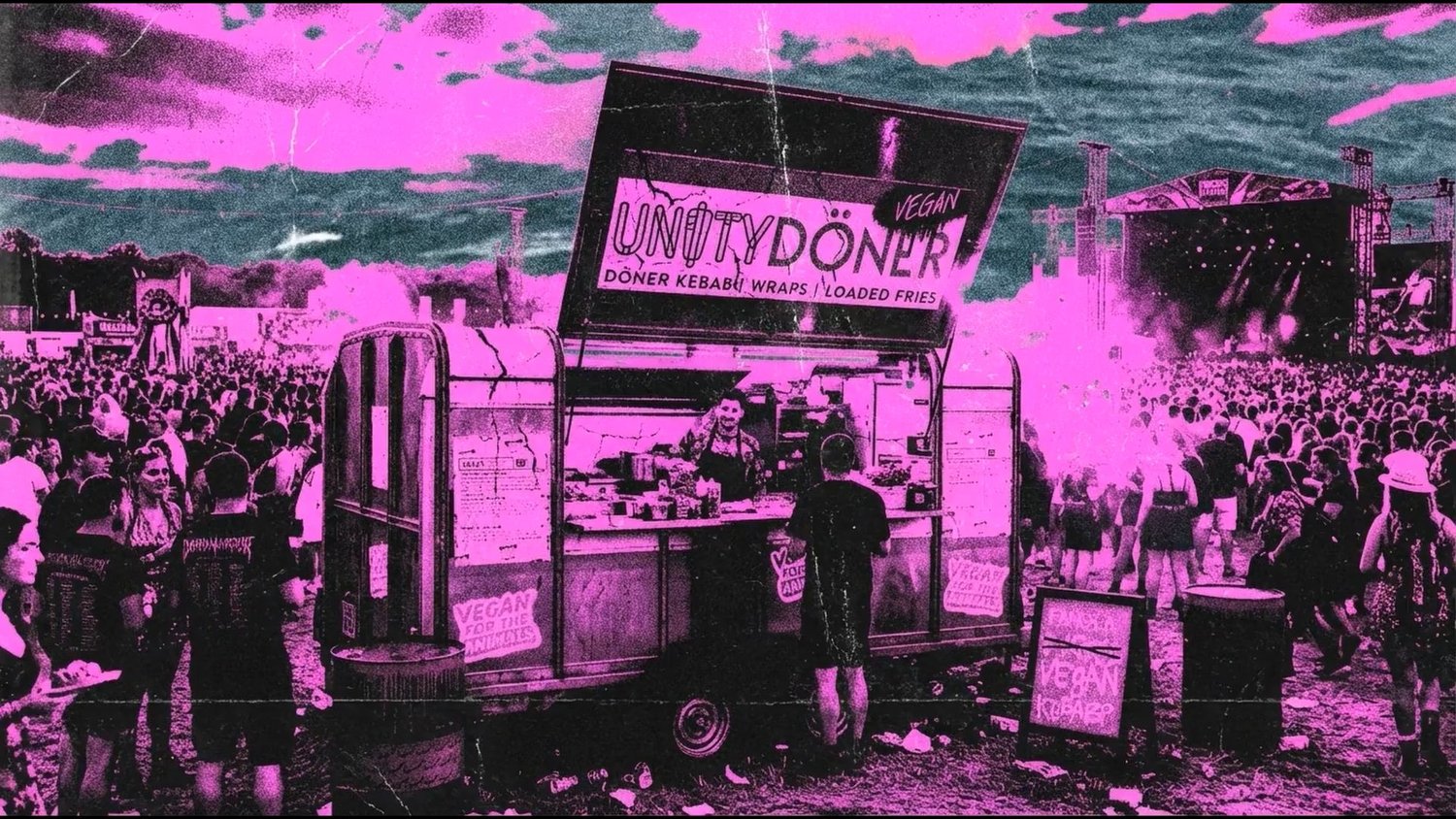

Venue 13 is joining forces with Soft Serve Cartel and Renewable Energy Vendors to bring the Edinburgh Fringe’s first carbon-conscious vegan food trailer to the festival this August 2026—and we are launching a crowdfunding campaign to make it happen!
Stationed at the foot of the Royal Mile outside Venue 13 (Harry Younger Hall on Lochend Close), this trailblazing project will run for the full Fringe duration from August 7th to 29th. It stands as the Fringe’s first food trailer powered by a hybrid renewable setup: a combination of quiet, emission-free hydrogen fuel cells and solar panels, complete with electrical battery storage to support heavy-duty festival appliances.
In this episode, Ian, Vanesa, and special guest Nico Barcella (founder of Soft Serve Cartel and co-founder of Unity Doner) unpack why this pilot project matters now. While most festival sustainability conversations stop at the lighting rig, food and beverage operations remain incredibly carbon-intensive, historically relying on loud, polluting diesel generators. This trailer serves as an open-source blueprint to prove that vendor cooking can run entirely on clean power at scale.
Inside the Episode:
- The Clean Power Equation: Vanesa discusses her background with Hydrogen Vehicle Systems Ltd (HVS) and how hydrogen perfectly pairs with solar to absorb peak energy loads, drastically reducing both air and noise pollution for the local Lochend Close community.
- Solar in the Arts: Ian shares his history designing solar projects in performance contexts, including a massive 2010 lighting installation at the Coachella Music Festival and bringing off-grid theater to Toronto with Vox Lumen.
- The Food Line-up: Nico talks about the community-driven ethos behind Soft Serve Cartel and his Unity Doner collaboration with Edinburgh’s own Considerit. He previews what’s cooking on the trailer—including spit-cooked vegan kebabs, oat-based soft serve, and an upcoming bubble tea partnership with Tempo Tea Bar.
- Climate Change Theatre Action: The team concludes the episode with a dramatic reading of Undertow, a brilliant short play about environmental empathy and finding the middle ground by Métis playwright Keith Barker.
Three Ways You Can Help Us Reach Our £6,800 Target:
- Share: Pass the announcement along to your favorite foodies, festival-goers, or climate enthusiasts!
- Donate: Support the live campaign directly on the Edinburgh Fringe’s crowdfunding platform to help cover council licensing and essential site infrastructure.
- Sponsor: Brands and organizations looking to put their name on a historic sustainability milestone can get in touch for custom trailer placement.


CCTA Plays Featured:
Undertow
by Keith Barker
Show Links
Food & Drink
- Soft Serve Cartel – https://softservecartel.com/ | Instagram: @softservecartel
- Unity Diner / Unity Doner – https://www.unitydiner.co.uk/ | Instagram: @unitydiner / @unitydoner
- Considerit – https://www.consideritchocolate.com/ | Instagram: @considerit_chocolate
- Plantuguese – https://www.plantuguese.com/ | Instagram: @plantuguese
- Sora Diana – https://www.thevegansora.com/sora-diana/ | Instagram: @thevegansora
- Tempo Tea Bar – https://www.tempoteabar.com/ | Instagram: @tempoteabar
- The Eating Gorilla – https://www.eatinggorilla.co.uk/ | Instagram: @theeatinggorilla
- The Tuskers – https://www.thetuskers.co.uk/ | Instagram: @the.tuskers
- Shore Seaweed (Crisps) – https://shoreseaweed.com/
- HappyCow App – https://www.happycow.net/
Shows, Performance Companies & Artists
- Ascension at Coachella Music Festival – https://inhabitat.com/coachellas-giant-origami-solar-powered-crane-installation/
- Puppet State Theatre Company (Mentioned for The Man Who Planted Trees) – https://www.puppetstate.com/
- The HandleBards – https://www.handlebards.com/
- VOU Dance Fiji (Mentioned for Are you Strong Than Winston?) – https://voufiji.com/
- ZATA OMM (Mentioned for Vox Lumen) – https://www.zataomm.org/
- Vox Lumen – https://www.ianpgarrett.com/portfolio/vox-lumen/
Festivals & Venues
- Arcola Theatre – https://www.arcolatheatre.com/
- Coachella Music Festival – https://www.coachella.com/
Arts, Sustainability & Technology Organizations
- Ashden Directory – http://www.ashdendirectory.org.uk/
- Centre for Sustainable Practice in the Arts (CSPA) – https://www.sustainablepractice.org/
- Creative Carbon Scotland – https://www.creativecarbonscotland.com/
- HVS (Hydrogen Vehicle Systems) – https://www.hvs.co.uk/
- Julie’s Bicycle – https://juliesbicycle.com/
- Theatre Green Book – https://theatregreenbook.com/
Transcript
Ian Hello and welcome back to podcast 13. I’m Ian…
Vanesa … and I’m Vanesa and we have a big announcement on this episode.
Ian This is episode nine and we’re using it to announce something we’ve been working on for a few months, a fully vegan, fully carbon conscious food trailer to go outside of venue 13 for the Edinburgh Fringe this August, which is going to be powered by a combination of hydrogen fuel cells and solar panels.
Vanesa And as far as we know, this will be the first time the Edinburgh Fringe has had a food trailer like this, so it’s a first for Venue 13 , a first for our partners at Soft Serve Cartel and Unity Donor. And the first two are renewable energy sponsors too.
Ian We’ve also launched a crowdfunding campaign, which we’ve mentioned in the last couple of episodes. This is going to help us make it happen. We’ll talk a bit more about it in the details about how you can support that later on in the episode, and we hope you’ll stick around for that.
Vanesa And we have a guest. We have Nico Barcella, founder of Soft Serve Cartel and co-founder of Unity Donor, who’s joining us to talk about the trailer, the food, and why this initiative is so close to his heart.
Ian So let’s dive in.
Vanesa Now let’s start with the basics. What is this trailer? Where will it be? When will it be there and what will it serve?
Ian So this is a fully vegan food trailer that’s going to be parked outside a Venue 13 at Harry Younger Hall on Lochend Close, right there at the foot of the Royal Mile. It’s open for the entire fringe run at venue 13. So, August 7th until 29th. We will have shows on, for it. It’s going to be taking up a couple of parking bays. This is how twenty thirteen is run. In the past, before where we’ve had box office and that. So we’re going back to that model because we’ve got more shows inside. So we’ve got to move the market stuff outside. It’s going to be powered by a hybrid renewable setup. We’re working out the fine details, but we’re working with partners. We’re going to be using a combination of hydrogen fuel cells to generate some of that power combined with solar. And there’s going to be some electrical storage that goes along with that to make it work for the appliances, to be able to serve ice cream and make the kebabs. We’re working with Soft Serve Cartel again. They brought in so many great plant based vendors last year, and in our interview, you’ll hear that there’s even more that we’re going to be working with, working on building this vegan festival community. This is going to hopefully build on our success from last year as the first fully vegan multi-venue venue, where we were working with soft serve cartel and Sora Diana, The Tuskers, Considerit Donuts and Shore crisps. At least one of those will be coming back as part of this year’s food offerings, and the goal is bigger than just serving food. Vanesa, what would you say we’re trying to demonstrate with this project?
Vanesa I guess this is a pilot study type project, and we’re trying to show the people of Edinburgh and Edinburgh in general, that a working, public facing example of festival food serving can happen when it’s running on renewable energy at scale. So, this is a proof that us, which are, you know, a medium sized fifty-seater venue, if we can do this, means that larger venues can do that too at, you know, at the Fringe Festival and other festivals that are outdoors. And so, this is a model that’s open. We want to share what works and build the blueprint so that other venues can follow. And this is tied directly to Venue 13 wider mission, which is to be fully accessible, inclusive, sustainable and artists first. Let’s talk about why this matters this year, because it is easy to assume that sustainability is already sorted at the big festivals, but it really isn’t.
Ian Yeah. Most large festivals around the UK, though many have done really excellent work. But for especially vendors and especially if they’re remote, they’re relying on either petrol or diesel generators to power things like the stage to provide power for all the vendors, the food vendors and some of the back of house too. So the food and beverage operations become a pretty carbon intensive part of any festival, probably more than people realize, because one tries to hide most of that infrastructure as much as possible, and they’re pretty noisy. So they also also tend to be moved as far away as possible from the stage because you want to hear. You want to hear what people are saying and what you know, and, and the music. So vendor power is particularly stubborn because when people are coming, especially if they have their own individual trailers, if it’s not something that’s provided for by a festival, they each need their own supply and they’re going to do what’s economic and works for them. Diesel tends to be cheap, and it’s very familiar to work with like the, you know, from small to large generators, they’re readily available. But it’s something that is both, I’d say stinky and noisy. So there is technology to replace it, but it sort of needs to be adapted to suit the purpose. We see a lot of things on the small end and a lot of things on the large end for like full sites down to like, you know, camping in that you’ll see like solar generators and things like that. And so we’re hoping that the will, the funding and the regulation are going to continue to catch up to this. And we’re going to see more people adopting things like this. So, you know, when you think about it in terms of like the wider sector of what we’re doing, you know, this is not something that we’re doing in isolation. We’re not the only people doing this.
Vanesa That’s right. And we have other organizations such as culture for Climate Scotland. Similar bodies have been making the case for years that the Scottish art sector needs to commit to net zero across the UK and international. We have festival operators, theatres and touring companies they are signing up to, for example, degrade the Theatre Green Book standards to these bicycle frameworks and similar commitments. The food side of Festival have lagged behind on the, you know, the production side of this commitment. Now, this trailer that we are, you know, trying to put together and make happen is a small attempt to push that conversation forward. Building on May thirteen is twenty twenty five milestone as the fringes first fully vegan multivendor venue and our Veganuary twenty twenty five mention. Ian, can you think of some of the points as to how this affects the people of Edinburgh, and why should they back this project?
Ian Well, I think anybody who’s gone to the theatre in the UK knows. And this is not just people who are there, but people who come and visit that, you know, it’s traditional to serve ice cream at the at the interval. That’s something that’s a very UK traditional thing to do. And there was a study in two thousand and eight that this is when Julie’s bicycle was just getting into theatre as a realm. They were commissioned by the Mayor’s Office of London to look at West End theatres, and people might not know this, but the concessions. So that includes chilling all that ice cream and then, you know, any drinks that you get, any snacks you get is more energy intensive than all of the stage technology by like multiple times. Yeah, it’s like two to three times the stage technology for all the lights, all the video, all the sound, all of those things that plug in that you see that like create the spectacle of a West End theatre production, that those are going to be like half or less of what it costs to, um, or what the environmental impacts are of serving ice cream and serving beer. And a lot of it has to do because it’s on all the time. So like, that’s something that everybody sort of interacting with. So when we look at these things and these alternatives to that, we start looking at, you know, how can we change these habits that we just sort of take for granted and we don’t really think about it. I’m sure many people just don’t think about that. You know, there’s a lot of direct impacts as well. We’re talking about cleaner air. There was, you know, the same sort of diesel generators that are used for festival power. And you don’t have like a place that you can plug things in, or you can’t tap into the grid or things that get used on film shoots. And there was a study done in Los Angeles around like the number of those that are used for film shoots, and they’re like a significant part of the air quality impacts in Los Angeles, which is also known for because of the car dependency, for having a history of not the cleanest air, it’s improved a lot. And part of that has been because, you know, they have like idling film trucks and the power that they need at these various places. So we’re just talking about cleaner air overall. If festivals aren’t using diesel and this is in Edinburgh or any places, they’re also quieter, hydrogen and solar, they’re silent. There’s not the constant rumble of a diesel generator. This oftentimes is a challenge for when you’re doing site planning, because you have to put them far away from where people are, or definitely where performers are. And in our sort of enclosed area, it sort of becomes a necessity to on on the close. We have a lot of people who are living there and they don’t want to hear, we don’t want to hear a generator, a motor, just going constantly throughout the day.
Vanesa I always make a point on that. It’s like, I feel like now people are setting up these organizations and new businesses, and sometimes just the noise pollution gets overlooked or people just like abide by the bare minimum where it’s like, I think it’s fourteen in lock and close. We have the community around the lake surrounding us. So, we have to think of as well, because we want to make friends and we want to be there for a long time.
Ian Yeah. And, and part of that community aspect then too, is that this then gives us a really unique way to support local food businesses who are looking to adopt a technology as people here in our interview with, with Nico, that, you know, there’s a lot of alignment between the way that we’re approaching food and the way that we’re working on this trailer as well. And Edinburgh itself is, is really not just a festival city, but it’s a place known for its climate leadership as well. So this is adding to that, combining two of the things that the city is really well known for climate leadership and the festival environment, and showing how those things can work together.
Vanesa I want to spend a few minutes on, um, you know, your back history because you have been working on solar in performance context for a long time now. Before this campaign, I want our listeners to understand where this comes from. So for listeners who haven’t met you on the podcast before, can you give us a quick sense of your work outside the venue? So that’s kind of, you know, you work in Toronto or other places and then as well as York University, the CSPA and how it all fits together.
Ian Yeah. So, my day job as a, as it is, is as professor of ecological design for performance at York University in Toronto. Not to be confused with the University of York. I’ve been there. And it brought me to Toronto in twenty twelve because that’s been a lot of my background. I actually started thinking I was going to go into architecture, and when I was training for that, it was as like the Leed certification, environmental standards were really taking root. And but I moved over to doing primarily theater design. And so, I took a lot of that thinking. And just like spending my youth being an environmental activist growing up in Los Angeles and started applying that to my practice. And then with a partner in two thousand and eight, co-founded an organization that still runs today as a nonprofit in Canada called the centre for Sustainable Practice in the Arts at the CSPA. And this has allowed me to connect research and my producing and design background, and I bring a lot of that to my work on the ground at the fringe.
Vanesa I see. And if I remember correctly, you initiated the Fringe Sustainable Practice Award back in twenty ten and co-directed it with Creative Carbon Scotland until 2017. And what was the gap that award was trying to close after that?
Ian So 2010 was my third festival, my third time coming to the festival, and I was thinking a lot about how a lot of people are coming from all over the world. There’s a lot of travel involved in it. And we were looking at paper waste, and we started organizing sessions with Fringe Central. We had a lot of UK partners and that. And so it was really about like one, our goal was how can we get people to tell us what they’re doing? How can we find out what people are doing around the festival and what sort of trends there are in terms of environmental consciousness? And we decided to go with a award because, like, everybody’s looking for ways to highlight what they’re doing and for ways to like make noise about their show.
And there was an organization called the Ashden Directory that would put together a list of environmental plays every year at the fringe. And so it was sort of based off of that. We’re like, how can we, you know, use that as a basis for reaching out to people who are already thinking about this and going beyond that and saying, let us know what you’re doing. It’s going to help us find out what people are doing. And also, you know, we have a long list and short list, and it allowed people to, you know, have another thing that they could talk about.
So it was really good for press. We had, you know, every year we had a company that had some sort of exemplary effect. It also led us to highlight different ways that people are approaching it because they’d be, you know, there were like looking at some of the highlights of people that that came across sometimes we did based off of topic. There were sometimes it was somebody who was local. So Puppet State Theater and their show, The Man Who Planted Trees did really well. And they won the award in one year. And their local Edinburgh based very conscientious and the type of content connecting with youth and that it’s a great show. They, they do tend to bring it back and do other work at the fringe too. So I highly recommend checking them out.
And we. Yeah, we also had, but we’ve had shows like there was a show from VOU dance, which they’re from Fiji and they were really sort of like nervous about receiving the award actually because of how far they had to travel. And they’re like, how could we claim this? But it was really about the environmental impact around what’s happening to them, to Fiji Around sea level and worsening cyclones, typhoons, hurricanes, whatever the local parlance is for that. So it was, uh, that show was called Are you Strong Than Winston? And it was named after a storm that they were reacting to.
So you have that and, you know, you have people inside theaters and then you had like the Handlebards, which also we gave a special mention to which, uh, they tore around on bike. They tend to do their show at the Botanics or another park space, and they’re doing completely off grid touring and presentation of really high-quality Shakespeare work too. So it’s all sort of variety of, um, of shows.
We did decide to end it after eight years because we sort of plateaued because so many new people come every year that, uh, in twenty eighteen, we’re like, oh, we’re just the work’s not getting easier for it. Is this the right way to do change? And there was also other groups that were looking to do more. Like there was another award that came along that we supported that another group is coming up from a different approach starting in twenty eighteen. Obviously, a lot of things changed a couple of years after that, and so we haven’t seen an award come back on that. But we have seen other initiatives like there’s some programming that that we’re talking about with the folks at the Theatre Green Book that they’ll be doing during the festival, at least for artists at French Central.
Vanesa Amazing. And going back to what you said about, you know, your background in Canada, in Toronto and other projects that you’ve worked on. Tell us about the solar projects you’ve actually designed and supported or studied. So, I know that our listeners would really like to, to hear more about one or two specific examples that they can picture.
Ian Yeah, I’ve got like two shows or two projects that I still get a lot of mileage out. So, my first opportunity to get to directly work with renewables was for a project for Coachella Music Festival in Southern California in 2010. Part of a team. Part of a group called the Crimson Collective, which is a large scale, looks like an origami crane, but massive. That was made out of truss and textiles, and I ended up coming on to it as a lighting designer. And in the lighting team, there were three of us, myself, an electrical engineer and a sort of solar foreman, somebody who installed solar systems. And we worked together to figure out how to light this giant sculpture up so that it could serve as a shade structure that people gather around during the day, and then at night would turn into this lit up sculpture that sort of, you know, was a beacon and another gathering point on sort of the, the skyline of the festival as well. And that’s been something that I know that a couple of years ago, someone created an augmented reality experience with like popular installations and artwork at Coachella’s past, and they included the bird in that one as well. I think it flies away in that one. It could not fly away. We had to design it definitely not to fly away during that time.
And then a few years later, I actually got to bring this into the theater where I was working with a company here in Toronto called ZATA OMM, and they had a project called Vox Lumen, where we did the entire thing off grid. So we worked with a couple of partners, both the local conservation area that had like a solar trailer they’d bring around for educational purposes. And then a company that made like charging stations that were solar powered for outdoor malls. And they deconstructed some of some of them for us. And so we put a solar installation outside the theater in February. The show was the first couple days of March, so winter in Toronto, and it charged batteries out there. And then we wheeled them in for the performance, and the entire performance was engineered. So I didn’t I didn’t do lights for it. I did the set design. But my colleague Simon Rossiter, who’s a lighting designer for that, we worked really closely together to sort of do a lot of the engineering where, you know, oftentimes we assume how much power we’re going to get just by plugging things at the wall. But because we knew we had a limited amount of it, and there were some quirks with how much we could use at any given time. We had a big partnership there, and then those both worked really well. So those are sort of two highlight projects. There’s been a lot of other opportunities to talk about how renewables integrate with what we’re doing in smaller projects like that, but those are those are ones that, oh, well, you should put the links into the show notes for that so that people can take a look at those. I’m pretty proud of those.
Vanesa Yeah, no, absolutely. I think people really like to have a look at that. So, from what you’re describing, you know, you are quite familiar with the best and the worst, I would say, of solar. And if we were to ask you, what is the, you know, the honest version of, you know, how do you really feel that solar would fare at the festival scale? Where does it shine and where do you feel like it falls a bit short?
Ian Well, you know, one of the one of the challenges is that a lot of people don’t understand what level of like how much space that you need and how much is generated by what, like they’re just not used to that. Our electrical infrastructure is really invisible to us most of the time. And so there’s, you know, one of the, one of the challenges is just that the temptation of tokenism, like putting a single photovoltaic panel out for solar up. When we were doing the project at Coachella, a lot of people thought it was like, is this powering the entire festival? And those of us who knew we were like, there is no way that is absolutely impossible. You do not understand how much power is being generated or not here. And so sometimes that can be challenging because people don’t understand like what we need, what sort of capacity that we need and how that is because we don’t live with it a lot, especially because a lot of our power sources are through fossil fuels and so they’re dirty. So we want them away from where we’re we’re living.
You know, I think one of the, the most common, I’d say misconceptions around, around solar is that is that, you know, you can only use it when the sun is shining and when it’s working. Now there’s a lot of engineering that goes into also just like the efficiency of it. So, Edinburgh tends to be very cloudy. We got a really nice, very sunny August last year, but you sort of have to design around the idea that you’re not always going to get that. They still work as long as there’s daylight at it, like out in it. But if it’s diffused in that, like the efficiency and the conversion can go down quite a bit. So you sort of have to think about that in a way that it’s not always going to be consistent. It’s more consistent than asking your audience to show up and turn a crank or something. But like, the sun’s going to be out, but how much it is. So there’s a lot of redundancy there. And then you have to talk about storage. So then there’s also like batteries, and then you have inverters. And where can you put these things and weatherproofing. And it’s not that any of this is particularly hard. We see solar installed in a lot of different places, but it’s outside of what we’re dealing with on a on a normal basis, we’re looking at the footprint for it and how we store that and how we make that available. That’s one of the particular challenges and what we’re trying to do with the trailer, right? Because we’re not going to be able to directly power an ice cream machine with any with solar, with any one individual, any one.
Vanesa Yeah. This has been in the renewables in my experience, has always been the long range, uh, question and debate that, you know, with diesel, we have, you know, the holy grail of the one thing that solves everything. And we are so used to just having that one solution, um, you know, at the cost of the noise and the pollution, but, you know, it is a very effective, you know, fuel that we have become so reliant on because it is effective. But if we’re going to go the renewables way, we have to think of, you know, a combination. And this is where it gets complicated because people, first of all, they’re not sure what it looks like, how much space it takes and what is required and which combinations would be as efficient as diesel. And then after, you know, there’s this whole, you know, mental workload of like, oh, if I’m going to do all of that, I might as well just continue using diesel generators.
Ian Yeah. I was going to say before you were at the kind arts and like primarily that, like you were, you were doing communications and corporate relations within a hydrogen vehicle start-up HVS, Hydrogen Vehicle Systems. Right. And this, this is an unusual background for someone to come into the arts with. Right. That’s a, that’s a new thing. And that’s, that’s the other part of this too. Like, we’re not just talking about like storage in terms of batteries and relying on solar, but, um, as we’ve indicated, it’s going to have hydrogen in it as well. How, how are we tapping into your background in that? How has that come handy in this in this project.
Vanesa Well, so my time at HVS was extremely educational. I’ve learned a lot about, you know, renewable industries, not just simply hydrogen, but many, many companies that were trying to do so many wonderful things. We did have and, you know, this is still ongoing, but I do feel it’s much better now a debate on, you know, sourcing the hydrogens and just general resource availability and, you know, how to transport this fuel from one place to the next. Is it going to be pipes? Is it going to be, you know, tanks? You know, where is it going to be stored? And I do believe that a lot has advanced since my time at HVS. I do still believe that hydrogen is a fantastic fuel source. And, you know, small concentrations can provide many, many hours of energy. So it does give you that, you know, really good, you know, bang for your buck type of thing. And it really does balance out the cost of the fuel. And I do believe that once the availability becomes, you know, much more accessible and the cost of it will definitely continue to go down. And people will see that the value really relies on switching to hydrogen and a combination of other renewables. You know, its waste by product is water vapor. It’s very quiet. And this is why it’s I believe it’s suited for applications like festivals. And, you know, because it, it can handle heavy duty long hours and intermittent demand. But parent hydrogen and solar is, you know, the practical answer potentially with some sort of, you know, electrical generators or batteries, solar handles the daytime baseline. And, you know, hydrogen carries the peak loads, maybe the early morning, the starts and together, I do believe that they will keep the the busy August trailer running without diesel.
Ian Yeah. And that’s an interesting thing because not like, you know, we will be the first to do this in Edinburgh at the festival in this way no doubt there. However, we won’t be the first theater to use hydrogen. The Arcola Theatre in London was using hydrogen nearly twenty years ago with um. Just happened to be that their general manager, Dr Ben Todd, whose background was in hydrogen development, and they created a whole offshoot called Arcola Energy. Now, when they moved that, I don’t think that they brought over the hydrogen generator. That’s so funny. In their in their space on Arcola Street in London that, um, they had to like to put special lights on it because people would get excited that, uh, we have a hydrogen that’s a power. It’s a, they had a theatre in which they’d power shows with, but it just looked like a small fridge. It’s like not an exciting device to look at. So they put like spinny lights on it. So, I guess everybody wanted to come see it.
Vanesa Because this was.
Ian Something.
Vanesa To see.
Ian Yeah. So, there’s something to see again.
Vanesa It’s a bit like the, the ATM machine that, you know, when it was about to give you your money, it makes the noise so that you know that the noise is not real, but it makes the noise so that you feel like, oh, something’s happening rates.
Ian It’s all those certifications there. But I think that it’s I think it’s like, you know, I’m talking about doing solar at a festival in 2010. Before that, there being a theater with hydrogen already powering a show. These are well-established technologies. And it’s sort of like obscene to me that these are not things that have been already done, that that we are the first. We shouldn’t be the first to do it. But I’m happy that we are the first to do it.
Vanesa And I’m happy to. So, here’s the practical bit. We have a live crowdfunding campaign hosted on the Edinburgh Fringe’s own crowdfunding platform. Now the target here is to get six thousand eight hundred pounds and what that money covers, you may ask so plainly, we are looking for, you know, the fees to cover the parking based on spaces where we’re going to put the trailer and we have a few licenses that we need from the City of Edinburgh Council. and these licenses are required to operate. Maybe, you know, a bit of logistics Portacabins basic infrastructure to set the trailer up safely for August. And what is a really secure in kind. Now, we do have our renewable energy equipment from the energy partners. We have marketing and PR from behind ours. We have the pitch location, and you know, all the backing from Venue 13 that they can possibly give us. And you also have the crowdfunder link, which we’re going to add to the description on the podcast.
Ian There are three ways that if you would like to help us, and we’d love it if you did that, you can do that. One is to donate. Obviously, it’s a crowdfunding campaign. Any amount that you can spare from one pound to, well, if you want to go the full thing, you just want to say that we’re going to sponsor it. We make it easy. There’s a number of awards there as well to keep track of what we’re doing over the course of the summer. But yes, donate any amount on that crowdfunder page. Every contribution gets us closer to being able to make this happen in August. If you do want to partner or you want to go beyond what’s there. If you’re a business, a brand, an organization that wants your name to the first carbon conscious vegan food trailer powered by renewable energy at the Edinburgh Fringe. Please get in touch. There are sponsorship opportunities as well beyond the crowdfunding itself. And so we’ve got that within the campaign and we can put stuff on the trailer itself. Shoot us an email, primarily get in touch with Vanesa. She is able to help set up all of those. And if you can’t do that, if you’re like, okay, you’ve just made it harder to do for it by saying like, I sponsor. What else can I do? Tell people, share it, post a link, tag a friend who loves vegan food. Tag a friend who works in festivals. Tag a friend who cares about climate. Tag a friend who is into renewables. Tag a friend who is a climate skeptic. Doesn’t know if vegan food can be delicious and doesn’t like dare them to come and support us and see what we’re doing as well. So, friends and foes alike tell them to come check us out so that they can see what happens when you put all these things together. But Vanesa, what happens if we hit that target, though?
Vanesa If we hit this target, you know, this happens. We do have the vegan trailer. You know, if we go past the oh my God, I can’t even I can’t even think if we if we hit this target, I would be first of all, I’ll be extremely happy. And then if we have, you know, if we’re going to be swimming in money here, we’re going to do more. We are going to do more in the sustainability aspect. We’re going to put the money to towards proper documentation, and maybe we can do a documentary. We can release that publicly so other venues can copy what we did. We can actually even look into further opportunities to how we’re going to adapt the market and market. Thirteen twenty thirteen versus terrible options in the future. And we’re going to just throw a big party. And everyone said firmly.
Ian I feel like in our conversation with Nico, there’s an indication that it wouldn’t be surprised if we’re going to have a bit of an opening celebration anyway. So also just like follow our social media, just so you know, when you can get a deal on delicious kebabs. Delicious. And you will have heard that we’re looking at bubble tea and of course, the ice cream for that. Like we’ve always got deals and they’re always giving away samples for the ice cream too. So, like if you just like lurk, you’re locking close in August, you can at least get samples of it of that there as well.
MUSIC BREAK
Ian And now our guest, Nico Barcella, who runs Soft Serve Cartel, which a lot of you will know from the iconic Dole Pineapple Twist, not to be confused with any other Dole based pineapple frozen dessert for legal reasons and oat based vanilla soft serve. He is also a founder of Unity Doner, which just opened a residency at Considerate Donuts in Edinburgh, serving spit cooked vegan kebabs. He will be the face of the trailer outside Venue 13 this August. Welcome, Nico.
Nico Barcella Hi guys. I’m really, really glad to be here with you.
Vanesa So glad that you’re here with us today Nico. So just to get into it, soft serve cartel started two years ago, roughly. Is that correct? Can you take us back to where the idea came from and what you’ve learned about Edinburgh’s vegan scene since you started?
Nico Barcella Roughly. It will be two years in August since the sort of concept began when to take you back to then. Essentially, I had been vegan for a number of years, and I attended my first sort of big vegan market, and I was looking around at how busy it was and how the vegan community responded to all of these small businesses in one place. Quite quickly, my opportunistic mindset, you know, had me looking around to see what do they have and what more importantly, don’t they have? So straight away it didn’t exist. And I quickly done some research and found out why it didn’t exist in these events. And it’s, you know, there’s a lot of logistics to it. The machines are heavy and they’re not easy to source and things like that. But never one to shy away from a challenge, I decided to go for it. So essentially it was born through a bit of opportunistic mindset, but also just looking at how the vegan community responds to small businesses. So, with the ice cream, for me, it was adding a bit of nostalgia into these markets. You know, vanilla soft serve ice cream with raspberry sauce, certainly in Britain has always been a huge thing for people of all ages. So, I went to my first market with my business partner Ben, and the response was incredible. We really couldn’t believe what the response was. And that first day. And since then, the idea has just grown and grown to the point that in Edinburgh in particular, we have such an amazing following no matter where we go. We have new people every time. So yeah, the vegan community in Edinburgh in particular are a very close-knit community. So for any small business, it’s a good way to get a foot in the door.
Vanesa Absolutely. You guys were pioneers and now, you know, like you said, you keep on innovating and innovating and we just can’t wait to see, you know, what’s the next thing? And speaking of the next thing, the unity donor considerate collaboration. That’s, that’s pretty unique. A vegan kebab, you know, cooked on a spit, you know, as opposed to just something that’s been like pre shaved, pre-packaged. Tell us about how that idea came together. Were you in collaboration already with, uh, with Unity Diner? These are London based, aren’t they?
Nico Barcella Basically, my ethos is always collaborative. I think in particular on small businesses, it’s really difficult to keep your head above water. So if we can all lean on each other a little bit, then it should certainly make things easier for us all. So part of my business model with Soft Serve cocktail is offering other small vegan businesses the opportunity to sell our ice cream. We provide a machine as well as the stock, and we work on a commission basis. So Unity Diner, where the first customer of that service. Somehow I found myself with a first customer five hundred miles away from where I live. But again, just back to that whole not backing down from a challenge. I headed down to London and met with the owners of Unity Diner, and we had to eat off quite well. The truth is that Unity Diner fund an animal sanctuary. And it’s a big a big dream of mine. So we very quickly got off the ground, became sort of what we would call now friends. And since then we’ve been thinking of ways to, you know, bring new things to the vegan community. What can we do to help the sanctuary and so on. So, you know, launched the League and kebab for the first time earlier on in 2025. And we had a chat about it because we know it’s the type of product that will do well at festivals and markets and things like that, because it’s very unusual. We see so similar to the ice cream, how that started. We just decided, well, I’m already travelling around the UK selling ice cream. Can I also do it with kebabs so that that’s how the, the kind of unity diner and becoming unity doner collaboration happened. And then again, because I travel around so much, I have the pleasure of meeting the different vegan businesses around the UK. So Considerit were people who had met at different markets. Again, we chatted. We share a lot in common, as do you know, most small vegan businesses. So when I visited the shop for the first time, I could see that there was two kitchen spaces. And because there are a bakery, then I knew that the shop was only essentially used half of the day. So I put forward an idea which involved me taking over, you know, one of the kitchens in the unit and allowing us to essentially offer a savoury option to complement the sweets. I speak a lot on this subject because I think it’s really important that, like I was saying earlier, if we can support each other, then we can all help guarantee each other’s futures and consider it. Have been there since, you know, roughly twenty eighteen, twenty seventeen. And I want to see that continue. I want to see that, you know, go on to the future. So if I can be part of something that allows them to bring in some extra revenue whilst also allow me to build upon my businesses, then it just made complete sense.
Vanesa I can see, yeah, I can see that in that answer. You’ve given us quite a lot that maybe our listeners haven’t taken into consideration before. When I met you, I do remember you’ve always been quite involved in animal wellbeing and supporting animal sanctuaries, and I’ve always admired that of you. I thought this was such a strong identification of someone that’s like vegan through and through, you know, this is for the animals and you’ve covered quite a lot there of my what was going to be my next question about, you know, what does the community involved in the community project from considering looks like to you? And I believe you’re just telling us that this is something about, again, immersing yourself in that community. Sharing what you can do with what they can do and making sure that they are, you know, they’re continuing there for longer.
Nico Barcella What I’m good at doing is spotting opportunities and things that, you know, other people maybe don’t see, or they pass by on it. For instance, within Considerit, it’s not somewhere I’m not there on a week to week basis. What I’ve went in there and done is taken my idea, put it in action. And now there’s extra local people who are get jobs, consider it have additional revenue coming in the vegan community, have a new product that they can go and try and enjoy. So for me, there’s a sort of multifaceted approach here. And one of them is how do you help the business community? So for instance, you know, within the non-vegan community, there are a lot of businesses which work together in order to get the best prices and things and so on and so forth within the vegan community business community. We’re all on such a small level, and we all operate mainly on a lifestyle choice as opposed to, you know, chasing money through business. So what you find with vegan businesses quite often is that their opening hours are shorter than, you know, what we’re used to.
Vanesa And yeah, that’s true. Yeah. That’s true.
Nico Barcella Yeah, yeah. They’re more inclined to take days off. They’re more inclined to shut if there’s terrible weather and things like that. So and I think all of these things are decisions that we would like businesses to make, right? We want people to look after each other and ensure staff are, you know, happy and so on and so forth. It’s hard to do that when you’re constantly chasing money, right? So for me, for instance, with the ice cream, it was about giving an ice cream machine, which allows them to bring revenue in without spending money. And they bring revenue in to share that with me. So the same kind of idea just opened in a different way with the kebabs, and that we were given a commission, a commission to consider it, which means that without doing any extra work, they’re able to get some extra cash. And the truth of the matter is, that’s the main thing for me. I think the whole concept of popping up in other people’s businesses will always be there and always have a chance to work. Um, I think what’s super important is that people who are established vegan businesses remain. So from the business angle, it’s about making sure anyone that’s currently open as a vegan business stays open as we all, anyone who eats vegan, anyone who’s in search of vegan food. Um, we are all so excited when new products come out. So from that side over again, there’s a little bit of, well, I’m getting the chance to go around the UK and try these things. I’m really quite happy and excited that I’m able to now that offering to other people. So community. Community. Community. One hundred percent.
Ian Well, I mean that that worked really well for us in collaboration last year. So I know that we were excited for like to, to figure out what we were going to do for Venue 13 this year, but we’re adding this twist to it, right? No, no pun intended around also looking at like the renewable angle for it a little bit related to like these principles of like, how about if we power it through hydrogen and solar? When, when that idea came up, what was your first reaction? What made you eventually say, yes.
Nico Barcella This is as exciting as bringing vegan ventures. I’m vegan for the animals, but I’m also I recognized that it’s not necessarily today’s thinking. It’s anyone who’s vegan today is maybe a little bit ahead of what is happening in the world, whether that’s purposely or just accidentally. But that’s the way I see it. And I think the same with renewable. I was driving an electric car in 2014 before anyone wanted to drive electric cars. And it seemed now that that idea for me of future proofing what we’re doing and reducing the harm and the things that we’re doing, because I think the important thing to remember is we all have a responsibility to ourselves and to the people around about us to ensure that today’s choices are better than yesterday’s. And I think renewable energy is the, you know, that’s such a good line because it’s it affects everything because, you know, there’s nothing that we do that doesn’t involve some form of energy. So, the simple idea of powering my food and dessert businesses with renewable energy. That’s just exciting to me. I know other people might find that dull or boring, but for me, I see that as being the future. I see that as the same way as bringing vegan food to Venue 13. Last year, during the fringe and stuff like that, this is it. The same for me. This is us solidifying that we are the future and everyone else will just be catching up with us. So yeah, any thoughts that I put or consideration? It was more so trying to contain my excitement because I genuinely think it’s a brilliant concept and a brilliant project that we’re sort of getting into now.
Ian Yeah. With all these exciting parts, what do you what do you think it might still get in people’s way of this? Like you’ve, you’ve mentioned in some of the press coverage that the donor is like almost identical to like a regular kebab and could even be better, right? I think that we’re seeing a lot of progress there too. So it’s like people are getting over a lot of stigmas around how they think about plant-based options and that they’re, they’re not going to be as satisfying for that. But, um, you know, aside from that, like, are there other barriers that you see to people like willing to, to try these things?
Nico Barcella I operate a lot on good customer service. I think the years that I spent working in restaurants and takeaway shops and things like that, you know, very, very much customer facing roles. I think that’s a big part of it. I think when people walk in somewhere and they’re met with vegan options, for instance, or a vegan restaurant, you know, that they’ve never experienced it before, so they don’t know the questions to ask. They don’t know necessarily that what things taste like, and they don’t want to spend their money straight away on something they don’t know. So, for instance, that was a big reason why when we launched Unity Doner in Edinburgh, we’d done a full day of, you know, giving kebabs out for free. We went into the Meadows and we were giving out samples. I had got local sort of activists and stuff to come in, to go out and do some footage and record some content, because I think just like the renewable thing, all of it is just that a sort of education process. And that’s not always education of the brain. It can be education of the taste buds. For me, that’s why doing all of this really excites me because like last year at Venue 13 , we’re going out to give out ice cream, giving out samples, doing things like that. It’s very much the same idea because although this is a business, absolutely. You’re introducing people to the the vegan food by way of coming and try this. Come and have a chat with us. No one here is going to be, you know, giving you a hard time or forcing anything on you. The food, the vibes, the, the overall sort of ethos of our company, like I say, is it’s about people essentially. We say community, but that that is just people. So whether that’s vegans, non-vegans or whatever. For me, it’s super exciting showing people what I believe is the future.
Ian The thing that comes to mind for me is that like, there are so many things, especially when we were also working with Sora last year, right? Where it’s just like the, there’s a point at which you just don’t think about whether or not like that it’s vegan or not, right? That it doesn’t have to be a modifier for it. It’s just, it’s just really good food. And it’s amazing food that we’ve been able to host before. So it’s like having a little food festival for the month for it. I know that we end up eating really well during the festival. I ate so much pasta last year and had so much ice cream, it was just like, do I need to eat more ice cream today? One of the things that’s exciting to us is that like, even before we were partnering, like, I know Vanesa and I were both fans of Considerit and we just happened to like, I think like a little over a year ago, we were both in London. We ended up going to like the unity dinner Sunday roast because it was just like, oh, we should check that out. So it’s like, it was amazing. Yeah, yeah. It’s exciting to see like things that we already love coming together like this, like totally that community vibe as well. But you’ve also said that this could be a blueprint for other businesses. Like what does success look like for self-serve cartel for the trailer for Unity doner, you know, you’ve started to put the ice cream machines in other businesses, as you’re saying, like, what does, what does, what does that blueprint look like? And how, what do you hope that that you get to? And at the end of that third year.
Nico Barcella The work that I’ve been putting in for the last couple of years and soft serve cocktail is it’s starting to really show now because, for instance, in the last week, I’ve had three different vegan restaurants reach out to me to ask if I’d be up for collaborating with them, because they’ve seen the work that I’ve done with Unity Diner, and they’ve seen my recent collab with Plantuguese in Bristol, and I guess it’s like any business, you know, I knew that at the beginning it was always about that. It’s about networking. It’s about building those relationships and friendships, and then people will start, they will start coming to you as opposed to you having to go to them. So for soft serve cocktail, honestly, if we want to talk, sky’s the limit kind of thing. I was nothing more than to see full vegan soft serve in places like Greggs, McDonald’s, places like that.
Ian And you have to be careful with the McDonald’s one, because then you’re going to get a reputation for your machines not working.
Nico Barcella So as far as I’m concerned, there is going to be a point. There’s a line in the sand at some point in the next few years where places like McDonald’s and things like that will start to recognize and see that at their scale, they’ll be able to produce vegan ice cream cheaper.
I’m already becoming known as the vegan ice cream person in the UK. Hence why people are reaching out to me. So if I can keep on that and I can build upon that to the point where I get maybe some high-profile people talking about me or, you know, whatever, whatever it may be. I think there’s every opportunity that these bigger, you know, huge multinationals will, uh, there’ll be an opportunity somewhere. And that’s just about me keeping the hustle up. You know, it’s, it’s just about the like these moments, having these chats with you guys, it’s about doing that as much as I can with as many people as I can, so that when people think vegan ice cream, they’re vegan ice cream, they think Nico from Soft Serve Cartek.
Um, so for the ice cream, that would be my, my kind of end goal. The truth is traveling to festivals and markets and things takes its toll. Not just on me, but also in vehicles and, you know, the fuel and stuff that’s required so sustainably or about sustainability going forward, I really wouldn’t want to be driving about in a van across country to sell ice cream. And that’s why I won’t. If you’re in Leeds, take an ice cream machine off me. If you’re in London, take an ice cream, you know, and that way I’m not actively having to go about and do these things that. But all these towns and cities already have the option. So for Soft Serve Cartel, that would be the, that would be the kind of long-term goal is to be able to secure a big contract for a that has multiple outlets and go from there kind of thing with unity donor. Um, I think very much that there’s an opportunity. It’s slightly different because it’s a bit more complex than the ice cream, but the same idea. I kind of want to just show people that what, what, what I’m doing is showing people that it exists, if you know what I mean. So just because you own a restaurant in Glasgow doesn’t mean that you necessarily know that you can now get vegan kebabs on a spit. Right. And then maybe they don’t know what type of equipment they need, what they don’t know, you know how to do it. So I see that as a potential route for unity donor as, as well as maybe opening a couple of sort of small like dark Kitchen, satellite kitchen type ideas.
Vanesa Oh that’s nice. Yeah.
Nico Barcella I think what we’ve done at Considerit is it can be done elsewhere. It’s just about having the right mindset. So when I, when I talk to people about it, it’s hard for them to understand that I’m not necessarily just looking for money off of them. So with the friends, I give them an ice cream machine for free and I give them stock for free and I take commission. The hardest part is getting people to believe that I’m not, you know, up to something untoward. They’re like, you know, no one gives things away for free. And I’m like, well, it’s not really for free. It’s just that I’m not making you pay anything up front and then I’m going to take money down the line. So.
Vanesa Yeah, I see, I see that, that, that can come across in a company. But like you said, though, a lot of vegan people do this because of the lifestyle, and there is not something like people usually will think about. Like if you think about it, every person that buys one of the kebabs, they will be in a way, supporting these animal sanctuaries that unity supports. And I think that’s fantastic. So, you know, you might say, you know, you are gonna given it for free. You’re getting money down the line. But at the same time, you, you do want to operate in that good faith.
Nico Barcella Yeah. I can’t think of a better way than building a relationship than showing people that they can trust me. And then they, they are then like, oh, okay, now I need to be kind to this person. Now I need to, you know, it’s, it becomes a mutual thing because I put the first foot forward instead of expecting them. And I think so again, like essentially what I’m doing is sales, right? But it’s just different sales. So most people have a really bad idea of a salesperson because a salesperson comes in and says, give me some money and then I’ll give you a product. I’m going insane. I’ll give you a product. Then you can give me some money. And the. You know, that’s a hard thing. Once that’s in action, it’s a hard thing for the other person to then, you know, mistreat me or take advantage of my business or, you know, they always feel a connection with me. And that’s why I’m, you know, I’m doing my best to keep the momentum going with this because I am I’m creating a connection between so many different vegan businesses around the UK now that there’s so many opportunities and so many things that I’ve got planned or in the pipeline, that’s not just food related.
Ian Are there new things that are, that are coming up? Like this is this is plenty you’ve got, but do you have… I can’t imagine you don’t have ideas about what you want to do next. Are there are there anything new coming up with Soft Serve Cartel new residences coming up?
Nico Barcella The one. The one that will just. So just set up, Plantuguese down in Bristol and they’ll be launching the ice cream this week, which is a very exciting collaboration. It’s getting an incredible response on social media. One of the owners of Plantuguese, he used to work at Unity Diner, so he knows the head chef and Unity Diner. And because of my collaboration there, he was chatting to the guy from Plantuguese, so Plantuguese then reached out to me. Um, and that’s quite a big deal because they had a very, very, very popular restaurant at the moment. Like they’re doing some, you should check out their menu online. Some of this stuff is it looks phenomenal. I mean, Bristol, don’t get me wrong, there is a quite a big collection of vegan places in Bristol, which was a shock to me. I didn’t again, I’m learning these things about different towns and cities as I go to them. You know, it’s not like I hold a vast knowledge of vegan establishments around the UK. It just so happens that when I travel to a certain town or city for events or markets. I then go online to the classic Happycow app and, you know, find out what restaurants are there. And then I think to myself, oh, could I pop in there for some lunch and see if they want an ice cream machine?
Vanesa Yeah, that’s a good idea.
Nico Barcella So, but, uh, you know, the one of the best things about it all is I’ve now got, you know, Sora Diana in Edinburgh’s got my ice cream. There’s a place in Leeds called Big Scott’s place in Wales called the Eating Gorilla. Now we’ve got Plantuguese and we’ll be back in Unity Diner for the summer again. And it’s such a pleasure knowing that I can go to all these places around the UK and go and get food, you know?
Vanesa Yeah.
Nico Barcella It’s like coming up as a celebrity. People are like, oh, Nico, you want something to eat? And I’m like, yes, I do.
Vanesa So behind everything you’ve ever done, I want to eat.
Nico Barcella Yeah.
Ian For your adoring fans that will be following you to each of these locations. You might happen to be in Edinburgh in August, who hopefully will come find us. Unlock and close with the trailer. What can somebody expect with the trailer? What do you want people to know about that? What you can have the kebab and soft serve. Are there other surprises or things you don’t have to give away? Any surprises? No spoilers, but what should somebody know about the trailer will have outside the venue this year.
Nico Barcella So we’ve already got a few things booked in for United Owner for the trailer. Now, the good thing with the trailer is this is where it’s obviously a bit different than restaurants, right? When you open a restaurant or you open a shop, your traditional shop, once you choose your lane, you’re in that lane. And if you change that lane, people start to question your business, right? Because if you open an Italian restaurant, then the next week it’s Chinese and then the next week it’s Mexican, people don’t like that. They want, you know, continuity. They want, you know, they want to know what to expect with the trailer. The good thing is that it never has to be one thing. So there might be events this summer where it’s united order and then there might be some events, for instance, where it’s Soft Serve Cartel and the Happy Fish because who doesn’t want chips and ice cream. But I also happen to be working on something else with a company called Tempo Tea bar, who were the first bubble tea shop in Scotland.
Ian And we’re going to tell them they’re going to have to hold Vanesa back, right? I think this year she had her first bubble tea. One of the trips to Toronto when we were presenting work here, and has been a bit of a theme since, so.
Vanesa I am obsessed. Obsessed with bubble tea. It’s just taken over my life.
Nico Barcella Okay, well, that’s good to know then. So. Well, basically, as you guys know. But the people listening won’t know. I also have a day job where I work for a charity, and I was out at an event for the charity one day and I met another guy again, just, you know, networking like I do for Soft Serve Cartel. This day I happened to be doing a different job, and I met a guy who turns out he owned Temple Bar who, as I say, the first bubble tea in Scotland. And then we got chatting and it turns out he’s got a van where the back of it’s converted to a snack van, etc. and they’ve not used it for quite some time. So, he’s like, would you like to collab? And we can maybe do bubble tea and ice cream? And I was like, yes, because unlike other people who are, you know, like I say when I say, do you want a free ice cream? They get skeptical when somebody says, do you want a van? I say, yes. I don’t think twice. We’ve currently got that van in the garage getting some work done. And then the hope is we will get that into some different events and things like that. For me, it’s just an absolute it’s something special that all of us are sitting down and coming together and making these things happen, that if it wasn’t for each of us, none of it would happen. And it just so happens that I’m the person that’s maybe putting the ideas together, but everybody else is there supporting the idea. And that’s just as important, if not more important, because an idea without execution is nothing.
Vanesa That’s true. No, that’s actually a very beautiful, you know, collaboration is the mother of success, essentially. So, thanks to everyone. You know, building that trust is everything’s happening.
Ian So as we as we sort of. We’ll give you plenty of time because it sounds like you might have a few more collaborations, some ice cream machines to give away. I don’t want to stand in your way of doing that, but if people want to follow along with these developments, we know that. We can find you on Instagram at Soft Serve. Cartel. Are there other places that people should be looking for you? We’ll put all these links and everybody that you mentioned, and anything that you might want to make sure that we highlight into the show notes and things like that. But is that the best way for people to follow you or are there are there other channels?
Nico Barcella We do we do have, you know, things like TikTok and YouTube and things like that. But Instagram is the place where we get most traction.
Vanesa Wonderful. And we’re going to ask our listeners to make sure to get a fantastic donor at Considerit. Uh, so that’ll be very exciting. For one, I actually haven’t had one yet, so I’m really looking forward to mine. But thank you, Nico. Honestly, thank you for, you know, for the food, for the time, for the chat, for the laughs. And thank you for backing this trailer with us. Um, we have been made thirteen funds of software now for a while, and we’re glad to be doing this together with you.
Nico Barcella Thank you guys. I’m thrilled to be part of this with you guys. Like I said when we met last year and none of us really knew exactly what we were doing or how we’re going to do it. I knew that it was the beginning of the future. Again, it’s just like the sustainable energy and the vegan thing. I’ve got a knack for seeing what the future could hold, and I knew that talking with you guys was going to lead to something special. And I think this year, all this sustainable energy, hydrogen food vans, you know, amazing artists and performers and everything all being part of the one thing. I couldn’t think of anything more exciting. I genuinely am genuinely very, very thankful to be involved. Plus, we had such good weather last year. I think we picked a good year for launch.
Vanesa We had an excellent, excellent weather last year, and this is what really was the driver. When we’re thinking about the renewable energy aspect and, you know, the potential to look into solar, you know, with, as we’ve mentioned earlier in the in this podcast about Ian’s experience with solar, my experience with hydrogen. I genuinely do believe that we can put something together here. And we’ve got so many more announcements coming up about, you know, the vendors are going to get involved, the renewable vendors that are going to get involved. And we’re very excited to start sharing as much as we can as everything comes together and with the crowdfunding campaign as well.
Ian So thanks again for joining us today, Nico, and recording with us. And I’m really excited for what happens next.
Nico Barcella Thank you very much. Thanks for the invite, I appreciate it.
MUSIC BREAK
Ian As always, though, we are going to include within this our episode here a reading from the climate change action, and one that we think ties into a number of these topics as well.
Vanesa These short plays continue to be really important, really close to our hearts. They bring together voices from around the world responding creatively to the climate crisis.
Ian This week, we’re going to be reading a play called Undertow by Keith Barker, who is someone that I’m, I’m pleased that I can say is as a friend is a citizen of the Métis nation of Ontario, Canada. He is a playwright, actor and director from northwestern Ontario. He was formerly the artistic director at Native Earth Performing Arts. He’s currently director of the Forrester Bernstein New Play Development program at the Stratford Festival in Stratford, Ontario. His awards include a Dora Mavor Moore Award, the Carol Bolt Award, Sadie SAT Award, and a Yukon Arts Award. Keith was a finalist for the Governor General’s Award in 2018. His plays are published through Playwrights Canadian Press.
In his note introducing Undertow, he says that Undertow emerged from numerous discussions with people around diverse political perspectives, reflecting his concern about the prevailing lack of empathy or understanding for differing viewpoints in a political world. Determined to polarize us, he attempted to write something that is closer to a real conversation, emphasizing not the dichotomy of right versus wrong, but rather the hopeful idea of right versus right, the art of finding a middle ground. I’ll also say that, conveniently, this play involves both mentions of delicious vegan cheese and electric vehicles specifically, so it seemed like an appropriate one for this.
There are two characters here. They’re siblings. One is grey and the other is Amber. Vanesa. Do you have a preference or a preference? Okay, I’ll go for grey. And we’ll also read the stage directions. And Vanesa will be playing Amber in this one.
Ian Grey is outside on the balcony. It is fall. There is a nip of cold in the air. Amber enters.
Mom sent you out to apologize.
Vanesa No.
Ian It’s okay if she did.
Vanesa Not everything is about you, Bud. I came out to get some fresh air. Dude, your house is way too small to be hosting this many people.
Ian You say that every year.
Vanesa And yet here we are.
Ian It is bitter that you had to spend two hundred bucks on gas to get here.
Vanesa What, are you going to be like that?
Ian Hey, I wasn’t the one yelling at the dinner table.
Vanesa You started.
Ian The. Don’t ask me what I think about your truck.
Vanesa I was talking about the color, not your opinion on the tailpipe emissions.
Ian How many trees do you think you’ll have to plant to offset the CO2?
Vanesa Do you ask that question to all of your lawyer buddies who drive SUVs to work.
Ian I try to lead by example. I ride my bike.
Vanesa So you don’t.
Ian I say to them what I say to you. Little changes go a long way.
Vanesa Well, here’s a little change I’d like to see. Stop telling everyone you’re vegan. Every second word of your mouth is vegan days vegan bad? Yes, we know because you never shut up about it. It’s embarrassing.
Ian Auntie Bev asked me what being a vegan means, and Rosie wanted to know if I still eat cheese, so I had to explain it to them again.
Vanesa You don’t eat cheese?
Ian Dude, how many times?
Vanesa I don’t keep track of what you eat.
Ian Actually, I found a really nice, fermented cashew cheese. You need to try.
Vanesa Stop. Those words. Don’t make any sense to me.
Ian Plant based alternatives are the way of the future.
Vanesa Yes. Sad future.
Ian Hey, I love a good cheese, but I hate factory farming. The impacts it has on the environment. So I gave it up.
Vanesa You fly for work? Isn’t that bad for the planet?
Ian I choose my airlines carefully, and I fly far less than I ever did.
Vanesa Wow. You have an answer for everything.
Ian Dude, I think about these things all the time. There’s not a day goes by.
Vanesa Stop it. Stop talking. Please. I came out here to get away from people.
Ian I’m gonna say one more thing and then I’ll drop it. There are seven billion people on this planet. And if everyone looked at their choices, consider their footprint and understood what small actions make a difference.
Vanesa Why can’t you just be normal?
Ian I was talking about the environment, not normal.
Vanesa I have neither the time nor the crayons to explain this to you.
Ian You have a one-year-old and another baby on the way, so you know what? Forget it.
Vanesa No. I’d like you to finish.
Ian You’re getting mad.
Vanesa It’s too late for that. Spit it out.
Ian Here’s what I don’t understand. Even if you don’t believe in climate change or you think it’s a hoax, why not do the little things scientists are asking us to do? In case you’re wrong.
Vanesa What if they’re wrong?
Ian Not the point. Small actions will make the world a better place regardless. Don’t you want to make better choices for your kids?
Vanesa You don’t know the first thing about my choices.
Ian You refuse to own a recycling bin.
Vanesa Not true.
Ian You don’t even have one in your house.
Vanesa It’s more complicated than that.
Ian And what about the composter I bought you a year ago? It’s still sitting in your garage.
Vanesa Well, yeah, but.
Ian You roll your eyes at the mention of renewable energy.
Vanesa Because it pisses me off.
Ian And you talk about being a meat eater like it’s a badge of honor with your guns and your hunting rights.
Vanesa No, no, no.
Ian And when the world is shifting to electric vehicles, you go out and buy the biggest truck you can find.
Vanesa Because I need it. The only reason you ride your bike to the office is because it’s twenty minutes from your condo. I need my truck to, you know, to go to job sites because I keep all of my tools in it. I might not be perfect, but at least I don’t go around lecturing people about things I don’t understand.
Ian No, you just scream terrible things at them at the dinner table in front of their family.
Vanesa You’re right. I shouldn’t have yelled at you like that.
Ian And I shouldn’t have made fun of your truck. I like the gray. It’s a good choice.
Vanesa Thanks. It’s electric.
Ian What? Why didn’t you?
Vanesa Because I’m exhausted. The baby’s not sleeping, so we’re not sleeping. I was excited to show it to you. But then you started lecturing me, and it pissed me off.
Ian You’re so stubborn.
Vanesa Okay. Dear judgey pants.
Ian I wasn’t judging you.
Vanesa Just so you know. I’m proud to be a hunter because I like to know where my meat comes from. I don’t want to buy something on white Styrofoam, you know, full of hormones that’s been fed GMO corn its whole life.
Ian What about tofu?
Vanesa Hey, if it wasn’t a forest and I could shoot it, then sure. But again, you’re buying something factory farmed, made with potential GMO soy, and who knows what else.
Ian That’s fair.
Vanesa And the reason I don’t own a recycle bin is because the town won’t extend curbside pickup outside the city limits, and the only recycling depot is over forty five minutes away.
Ian Maybe I can help.
Vanesa What? On your bike.
Ian Well.
Vanesa And yes, it’s true, I haven’t set up the composter yet. And that’s because when the baby arrived, our lives descended into chaos.
Ian Right?
Vanesa And the only reason I roll my eyes at renewable energy is because it’s way too expensive. I wanted to get solar panels for the shop, but I can’t afford it.
Ian I’m sorry. I was judging you on things I didn’t know about.
Vanesa You were, but I was also.
Ian I’m the worst.
Vanesa Listen, I’m going to say this once you repeat this, and I will murder you in your sleep. I read the articles you sent. I look at the websites you tell me to look. I even listened to that podcast you sent me. That stuff can be annoying. Like really annoying. But I kind of like it, too.
Ian You do?
Vanesa I just wish you’d acknowledged that these things are more complicated than black and white sometimes.
Ian I know I will, I promise.
Vanesa Okay.
Ian You’re really gonna like that cashew cheese.
Vanesa Ripped up where.
Ian You tried it.
Vanesa Damn, it is good.
Ian I told you.
Vanesa Yeah, yeah, of course you did. Let’s get back in there. I gotta tell mom I fix this.
Ian I knew that she sent you out here.
They exit together
End of play.
Ian I’m really curious to know what you thought about that one, Vanesa, because I realized in reading it that you ended up playing something that I was so the opposite of you, effectively.
Vanesa That is absolutely fine. When I was in college, I was part of a debate group and we had to do this debate to pass. It was it was really important that we you know, that you made a good argument. And I had to defend Sea World. I had to defend Sea World and everyone knew I was vegan. And that’s why they gave me Sea World to defend. And it was the hardest thing in the world to do because I, you know, I don’t I’m in favor of captivity for entertainment or any other reason. And it was just so hard to, to defend this organization. So when I had to play the Hunter just now, it was like, oh, here we are again. I’m in college defending Sea World.
Ian You’d be great for that.
Vanesa Thank you very much.
Ian So here we are at the end of another episode. Big thanks to Nico for joining us. Are you going to be able to check out the, uh, the unity donor residency at Considerit?
Vanesa I am considering that, yes, I’m considering it to go to Considerit to check the system. Ha ha ha. Um, yes. If you’ve enjoyed this episode and you want this trailer to happen always, please do go to Edinburgh dot com. We’re going to send the link there, the low-end, chip in, whatever you can.
Ian The funny thing there is that, uh, and if people recall back to the interview, Nico mentioned that they have like this unused kitchen space, which is why they did they consider it, uh, part and I remember that before Considerit was Considerit. It was. And I feel like I only got chips there once, but it was my favorite named chip shop. Even though I feel like, like I said, I’ve been there once, which was the Codfather. I just thought that that was like punny and appropriated it.
Vanesa But I think we need to create another crowdfunding campaign. Ian. I believe that pawn shop stuff with like puns for names are dying out because my favourite shop in Tollcross, the Thailander, is no longer and I. I’m so sad.
Ian Yeah, we should though with a with it where our venue is just venue.
Vanesa Just we’re just venue keeping it simple for just venue. Maybe we need to create a pun.
Ian Yes. Well, so if you donate enough to our crowdfunding campaign. No, you can be part of the. We’re going to end up with like Boaty McBoat Face. We’re going to be Venue McVenue.
Vanesa Oh my goodness.
Ian All right. I think we’ll stay with Venue 13 for now. So regardless of that, please do consider donating, sponsoring, sharing all three of those help with crowdfunding campaign. What do we say now.
Vanesa Thank you for listening.
Ian Yes, we’ll see you next time. Thanks for listening.
Thanks for listening to this week’s episode. If you enjoyed the conversation, make sure to hit subscribe. That’s also how you’re going to find out more about our progress with our crowdfunding campaign and the trailer. So just like that and other updates, you’ll never miss them. You can find us wherever you get your podcasts. We’d love it if you could leave a review, wherever that happens. As you can tell, we are just defining that niche right there. So make sure that you help us out there. It’s very competitive. If you’ve got thoughts, questions, or ideas for future episodes, we’re going to be talking a lot to the artists that are going to be presenting. So you’re going to hear us at a more regular clip moving forward. As we move forward to August, we’re going to talk to everybody before we get there. So you can hear a bit about those shows and we can share information. Those do go on sale on May six. We’ll see if this episode gets out ahead of that time. We’re going to aim for it. If not, it will go out that week and you’ll start hearing lots of information about the great program that we have at Venue 13 . But if you want to talk to us about the podcast, you can reach us at podcast at Venue13.com. For any of those topics, you can reach us across social media @Venue13Fringe . That’s number thirteen @Venue13Fringe. Our back episodes and transcripts for all the episodes can be found on our website at Venue13.com/podcast. Or just go to it and click on podcast.
The music that you heard through the episode is by Dusty Decks, which we licensed through Epidemic Sound, and this week’s CCCTA reading was Undertow by Keith Barker.